Dnipropetrovsk Investment Agency (DIA) has prepared an overview of the international cooperation of Ukraine and Dnipropetrovsk region amid the aggression of the russian federation. The material focuses on the support of Canada and foreign trade indicators based on DIABASE data.
Canada remains one of Ukraine’s most reliable and consistent partners, providing extensive military, financial, humanitarian, and energy assistance. Since 2022, Ottawa has committed approximately $18–22 billion in comprehensive aid, marking one of the highest per capita contributions among G7 nations.
In 2025, the Canadian government continued to tighten economic pressure by introducing new sanctions. These measures included export bans on components for chemical and biological weapons, industrial goods, and dual-use technologies, alongside import restrictions on coal and metals. Furthermore, Canada blacklisted three financial institutions that helped the Kremlin bypass international restrictions, and sanctioned 17 individuals linked to Russia’s quantum technology sector. The sanctions also targeted over 40 entities and more than 200 vessels operating within Russia’s shadow fleet.
Over the past year, Canada delivered a broad spectrum of weapons and hardware to Kyiv. Shipments featured 80,840 CRV-7 rocket motors and 1,300 warheads, 970 C6 machine guns, and 10,500 9mm pistols. Additionally, Ottawa supplied decommissioned chassis from M113 and Coyote LAV armored vehicles to be repurposed for frontline needs. Later in 2025, Canada provided Coyote and Bison armored vehicles along with electronic warfare systems as part of a fresh aid package valued at over $25.5 million.
Aviation cooperation has become a cornerstone of the bilateral military partnership. Canada allocated $284 million to enhance F-16 pilot training under the Air Force Capability Coalition of the Ukraine Defense Contact Group. This program funds the training of Ukrainian Armed Forces pilots and provides critical equipment to secure F-16 operations at Ukrainian airbases. Canada also hosted Ukrainian pilots at the Canadian Forces Language School for specialized training and supplied maintenance equipment to Denmark and France to support their respective instruction programs.
Another vital milestone was the extension of Operation UNIFIER, Canada’s military training mission, for an additional three years until 2029. This extension increases the deployment of Canadian Armed Forces personnel dedicated to training Ukrainian troops. Since its launch in 2015, Canadian instructors have trained over 47,000 Ukrainian soldiers and security specialists.
Marking the fourth anniversary of the full-scale invasion, the Canadian government announced one of its largest security assistance packages to date, totaling $2 billion for the 2026–2027 fiscal year. The package outlines the delivery of over 400 armored vehicles, including 66 LAV 6.0 light armored vehicles manufactured by General Dynamics and 383 Senator armored vehicles produced by Roshel.
Alongside its military commitment, Canada continued to fund humanitarian relief and early recovery initiatives. At the beginning of 2026, Ottawa pledged over $35 million for humanitarian and reconstruction projects focused on supporting internally displaced persons, reinforcing the healthcare sector, and restoring social and critical infrastructure.
Energy security remained a top priority. Canada consistently contributed to the Ukraine Energy Support Fund, backed the restoration of damaged power facilities, and expanded its partnership with Ukraine to deploy renewable energy solutions and boost grid resilience. In February 2026, Canada injected an additional $20 million into the Ukraine Energy Support Fund to rebuild and fortify energy infrastructure.
The development of mutually beneficial trade and economic cooperation remains a key priority for Dnipropetrovsk region. The volume of the regional exports and imports with Canada demonstrates the strength of the partnership
According to results for the first nine months of 2025, the volume of goods exported from Dnipropetrovsk region decreased by 31.3% and amounted to $51.7 million. Among the goods in highest demand among Canadian consumers are non-organic chemicals, ferrous metal products, copper and copper products, vessels, and others.
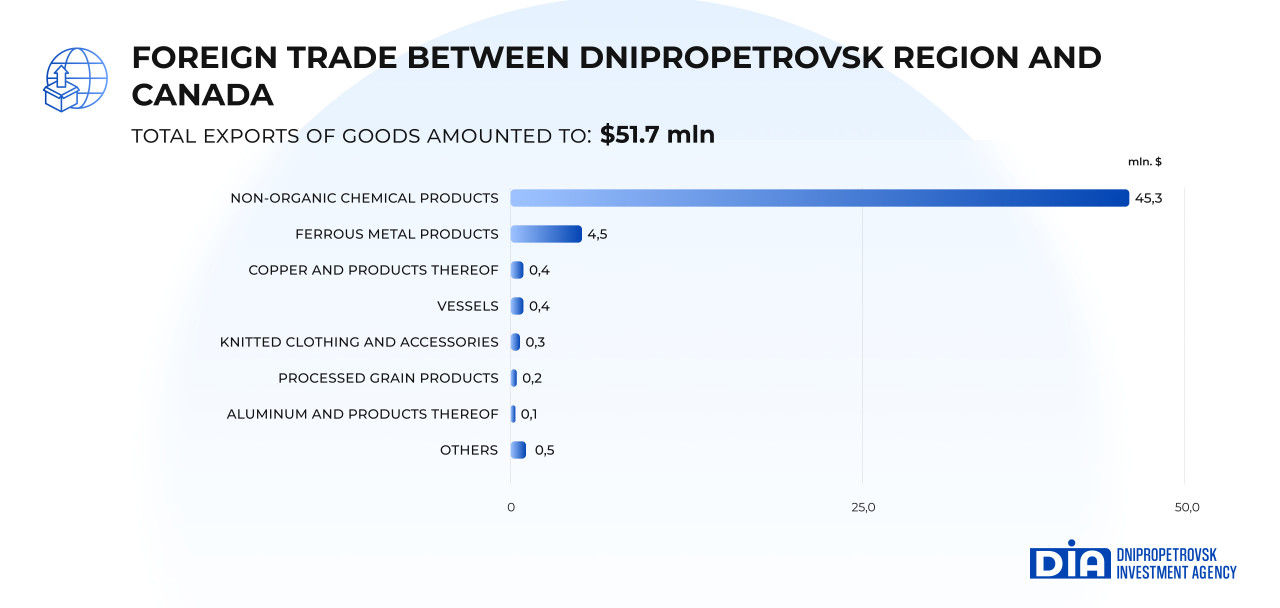
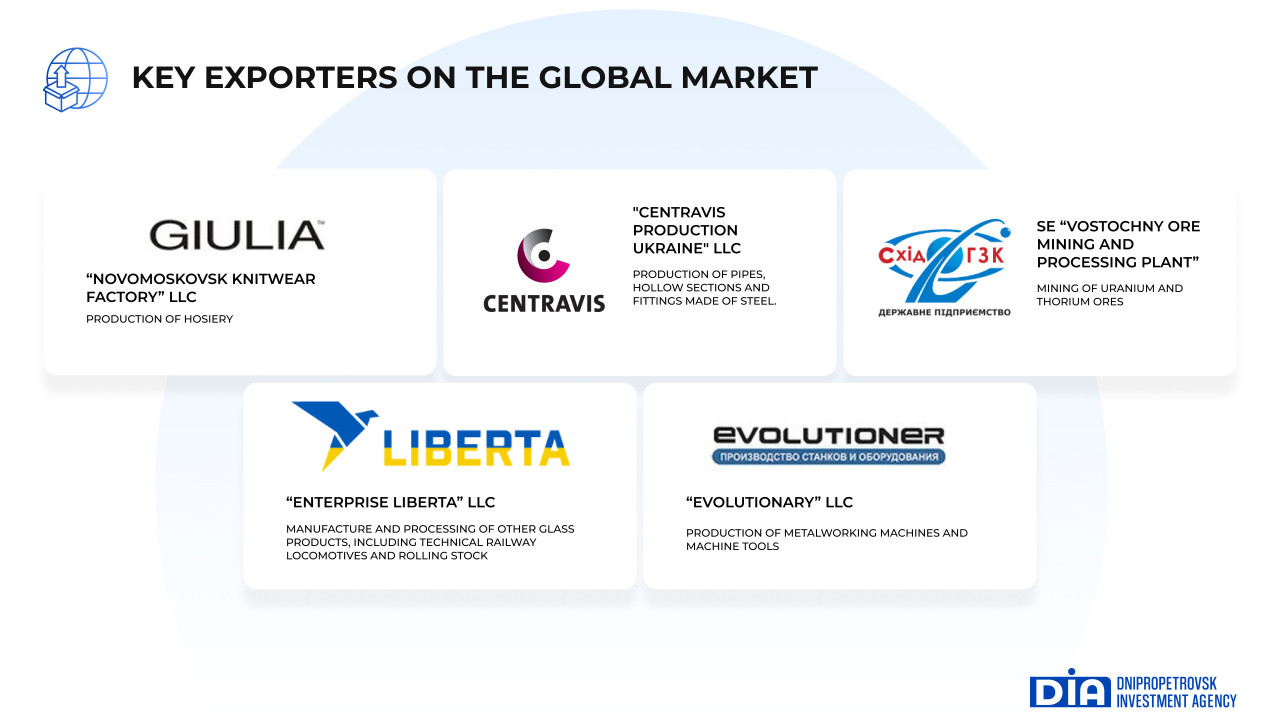
Export operations were driven by more than 40 companies based in Dnipropetrovsk region, led primarily by businesses in the chemical, light industry, metallurgical, and mechanical engineering.
TOP-5 exporting enterprises (ranked by export volume):
Imports of goods from Canada to Dnipropetrovsk region totaled $36.1 million, an increase of 7% compared to the same period in 2024. Dnipropetrovsk region traditionally imported: oil and its distillates, fish and crustaceans, electrical machinery, machinery and equipment, and other goods.
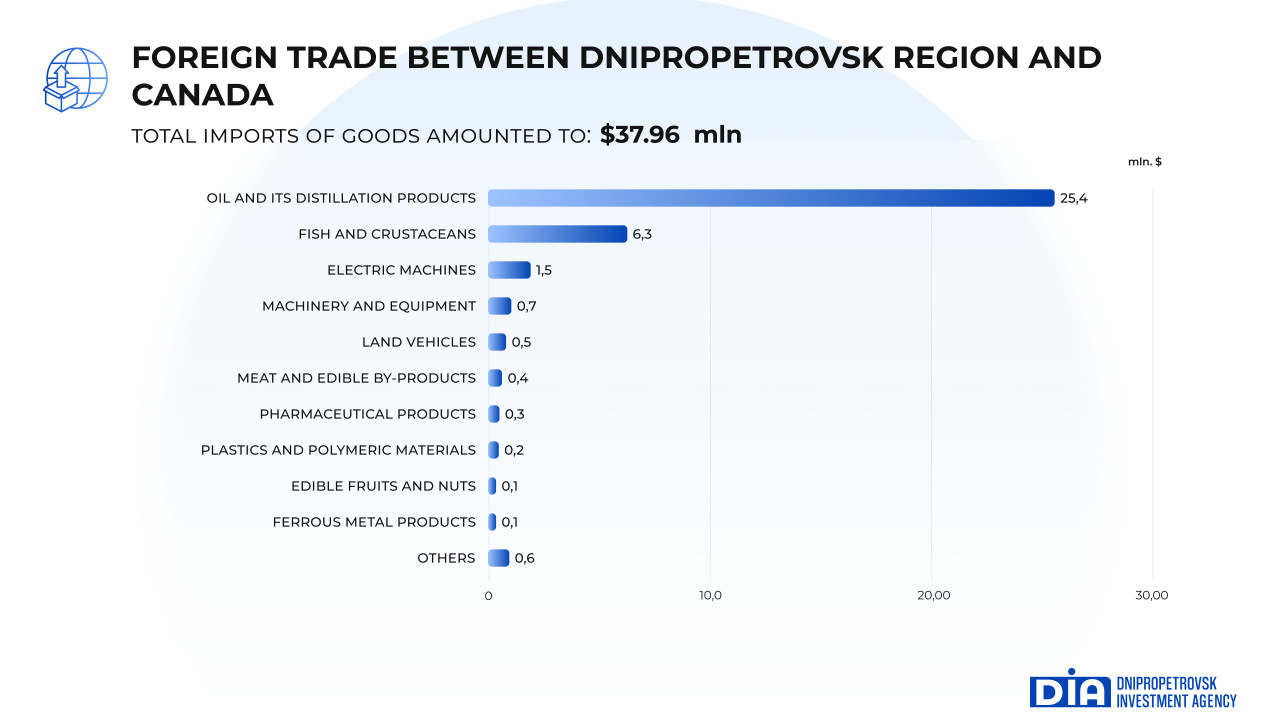
Import operations involved more than 80 local importing businesses.
TOP-5 importing enterprises (ranked by import volume):
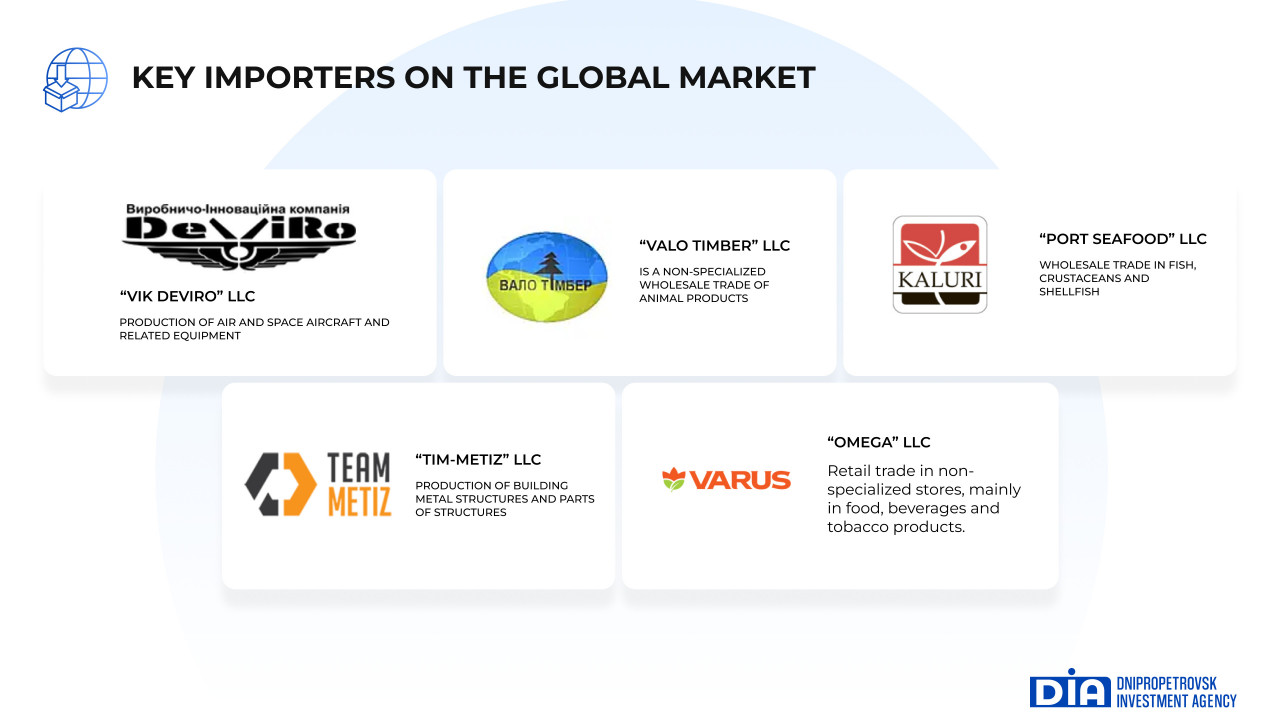
Import activities were predominantly carried out by commercial trade firms, machine-building companies, food processors, and agricultural enterprises.
Source: information for the preparation of the article was taken from open online sources