The Dnipropetrovsk Investment Agency DIA offers an overview of the level of interaction between Ukraine and Dnipropetrovsk region with other countries amid the unprovoked military aggression of the russian federation against our state. In this publication, we offer informational material on the support provided by Slovenia and the level of foreign trade, formed on the basis of DIABASE data.
Since the beginning of the full-scale invasion by the russian federation, Slovenia has consistently supported Ukraine, combining military, humanitarian, and financial assistance with participation in reconstruction, humanitarian demining, rehabilitation of victims, and support for European integration. For a relatively small European state, the scale of this support is substantial. According to preliminary data from the Government of Slovenia, the total volume of assistance to Ukraine has exceeded €163 million.
At the political level, Slovenia remains a firm supporter of Ukraine’s sovereignty and territorial integrity. Ljubljana advocates for a just and lasting peace based on international law and the UN Charter, continued pressure on russia, and holding those responsible for crimes against Ukraine accountable. The Slovenian side also emphasizes that the russian federation, as the aggressor state, must be held responsible for the damages caused to Ukraine.
Over the past year, political dialogue between the two countries has remained active. In October 2025, during an official visit of a Slovenian delegation to Ukraine, negotiations were held with the country’s leadership and the Ministry of Foreign Affairs of Ukraine. The parties discussed international efforts aimed at achieving a just and lasting peace, the return of forcibly displaced Ukrainian children, strengthening international pressure on russia, the reconstruction of the country, and Ukraine’s further progress toward European Union membership.
At the same time, Slovenia is sharing its own experience of European integration with Ukraine. Particular attention is paid to regional policy, decentralization, and the management of structural funds. In October 2025, a memorandum on technical cooperation in the field of regional development was signed, and in November a Ukrainian delegation worked in Slovenia to prepare for negotiations on Chapter 22, “Regional Policy and Coordination of Structural Instruments.” Slovenian experts shared their experience in managing EU funds, multi-level governance, implementing Interreg programs, and organizing interaction between the state, regions, and communities.
Slovenia’s role in Ukraine’s recovery is gradually increasing. In 2025, the country allocated more than €5 million in official development assistance directly targeted at Ukraine, and for 2026 the volume of such support was increased to over €7 million. The priority areas identified are humanitarian demining, education, assistance to vulnerable population groups, institutional capacity, and infrastructure reconstruction.
Slovenia’s approach to reconstruction is gradually changing. Since 2024, most programs have begun shifting from emergency response to recovery and development. Slovenia is increasingly involving its own organizations, expert institutions, and companies, sharing with Ukraine its experience in infrastructure, public administration, finance, rehabilitation, and demining.
One specific example was the reconstruction of housing and educational infrastructure in Kharkiv region. From May to October 2025, with funding from the Ministry of Foreign and European Affairs of Slovenia and the participation of Caritas Slovenia, a project with a total value of €400 thousand was implemented, of which Slovenia provided €360 thousand. In the eastern, central, and southern parts of Kharkiv region, approximately 80 war-damaged houses were restored, in which at least 240 people live.
Within the same project, a school serving 14 surrounding settlements was restored. Thanks to the reconstruction, more than 600 children and nearly 70 staff members of the institution regained access to educational infrastructure. Thus, Slovenian assistance was directed not only at repairing individual facilities but also at restoring basic services and normal life to communities affected by hostilities.
In February 2026, Slovenia joined the restoration of Ukraine’s energy sector. The government approved a decision to contribute €500 thousand to the Ukraine Energy Support Fund, which operates under the Secretariat of the Energy Community. The funds are intended for the restoration of energy infrastructure damaged or destroyed by russian attacks. The decision was made against the backdrop of a particularly difficult situation in the winter of 2025–2026, when large-scale strikes on energy facilities led to disruptions in electricity, heating, and water supply in Ukrainian cities.
Military assistance remains a separate component of Slovenian support. Ljubljana does not publish a full list of military equipment transferred to Ukraine for security reasons. At the same time, Slovenia continues to fulfill the bilateral Agreement on Cooperation in the Field of Security and long-term support, and also participates in EU and NATO mechanisms.
The Republic of Slovenia has also joined the NATO PURL (Prioritised Ukraine Requirements List) initiative, through which European partners and Canada finance the procurement of priority American weapons for Ukraine. Slovenia’s contribution was primarily oriented toward strengthening Ukrainian air defense to protect the population and critical infrastructure.
An important part of military support is the training of Ukrainian servicemen. Slovenia continues to participate in the European Union Military Assistance Mission in support of Ukraine (EUMAM Ukraine). Up to 30 Slovenian servicemen and civilian specialists may be involved in the mission. Slovenian instructors have been working since 2023, conducting command-staff, individual, collective, and specialized training of Ukrainian military personnel on the territory of EU member states. This work continued in 2026.
Cooperation between the defense industries of the two countries is becoming a separate promising area. During negotiations in Kyiv in December 2025, the parties discussed possibilities for cooperation in the production and development of unmanned systems, air and counter-drone defense, cyber defense, armored vehicles, and artillery. The Slovenian side is interested in using the practical experience of the Ukrainian defense industry, which, under wartime conditions, quickly adapts technologies to changes on the battlefield.
One of the most characteristic areas of Slovenian assistance is humanitarian demining. The country has significant international experience in this field through the ITF Enhancing Human Security fund, established in Ljubljana. Ukraine has become one of the key areas of its activity. Slovenian support covers the clearance of territories from mines and other explosive hazards, the training of specialists, assistance to victims, and the development of Ukraine’s mine action system.
Humanitarian assistance was also increased in 2026. The Government of Slovenia has allocated at least €7.2 million in humanitarian support for Ukraine. Funding is channeled through Slovenian organizations and international humanitarian structures, including ITF, Caritas Slovenia, the UN World Food Programme, the World Health Organization, and the International Committee of the Red Cross.
A special place in Slovenian programs is occupied by the rehabilitation and psychosocial support of children. In Zhytomyr region, Slovenia supports the “Nadiya” (Hope) rehabilitation center in Zarichany, which works with children and youth with special needs. In 2026, almost €197 thousand was allocated for the relevant project. Two two-week rehabilitation and psychosocial programs are planned for 60 children and young people and their parents or accompanying persons.
Assistance to the center also has an energy component. 113 solar panels with a total capacity of 70 kW are being installed on its territory. This is intended to ensure the stable operation of medical and rehabilitation equipment, heating, and lighting even during prolonged power outages caused by russian attacks.
Medical rehabilitation also remains an important area. Slovenia has many years of experience in treating and rehabilitating war victims through the ITF Enhancing Human Security Fund and Slovenian medical institutions. At the end of 2025, the Ministry of Defence of Slovenia additionally implemented a civil-military project to equip a rehabilitation facility in Drohobych.
Direct humanitarian support from Slovenia has also reached Dnipropetrovsk rehion. In October–November 2025, with funding from the Ministry of Foreign and European Affairs of the Republic of Slovenia, Caritas Slovenia implemented a humanitarian project in Dnipropetrovsk, Zaporizhzhia, and Sumy regions. Under the program, 370 households in the three regions received financial assistance to purchase solid fuel for the heating season. The total value of the project was €411 thousand, of which €400 thousand was funded by the Government of Slovenia. The assistance was primarily targeted at the most vulnerable households and internally displaced persons, aimed at ensuring the basic needs of the population amid the war and a difficult winter period.
In July 2025, Slovenia joined the European mechanism supporting trade with Ukraine, the InvestEU Ukraine Export Credit Guarantee Facility. The Slovenian export and development bank SID Banka received €24 million in guarantees from the European Investment Fund (EIF) under the program to support Slovenian small and medium-sized enterprises and mid-cap companies exporting goods and services to Ukraine. The mechanism is designed to reduce trade risks under wartime conditions and facilitate the supply of equipment, construction materials, modern technologies, and other goods necessary for the functioning and recovery of the Ukrainian economy. In parallel, Slovenia is expanding long-term cooperation with Ukraine in the field of infrastructure and energy reconstruction, decentralization and inter-municipal cooperation, public administration development, economic growth, and the green transition.
The development of mutually beneficial trade and economic cooperation also remains an important priority for the two countries. An analysis of export and import operations between the Dnipropetrovsk region and Slovenia demonstrates a high level of partnership relations, as this state is an important trade partner for the region.
Based on the results of 9 months of 2025, the volume of goods exports from Dnipropetrovsk region decreased by 5.3% and amounted to $6.8 million. Among the goods in demand among Slovenian consumers are parts of railway locomotives, ferrous metals and articles thereof, fats and vegetable oils, articles of stone, plaster, etc.
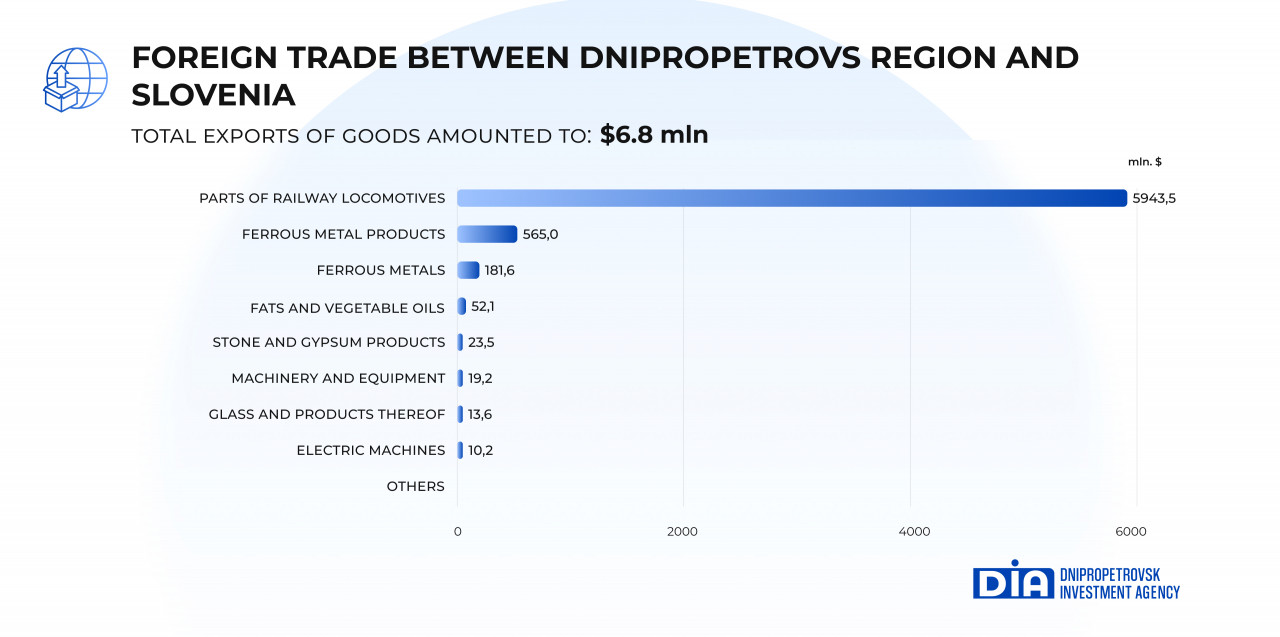
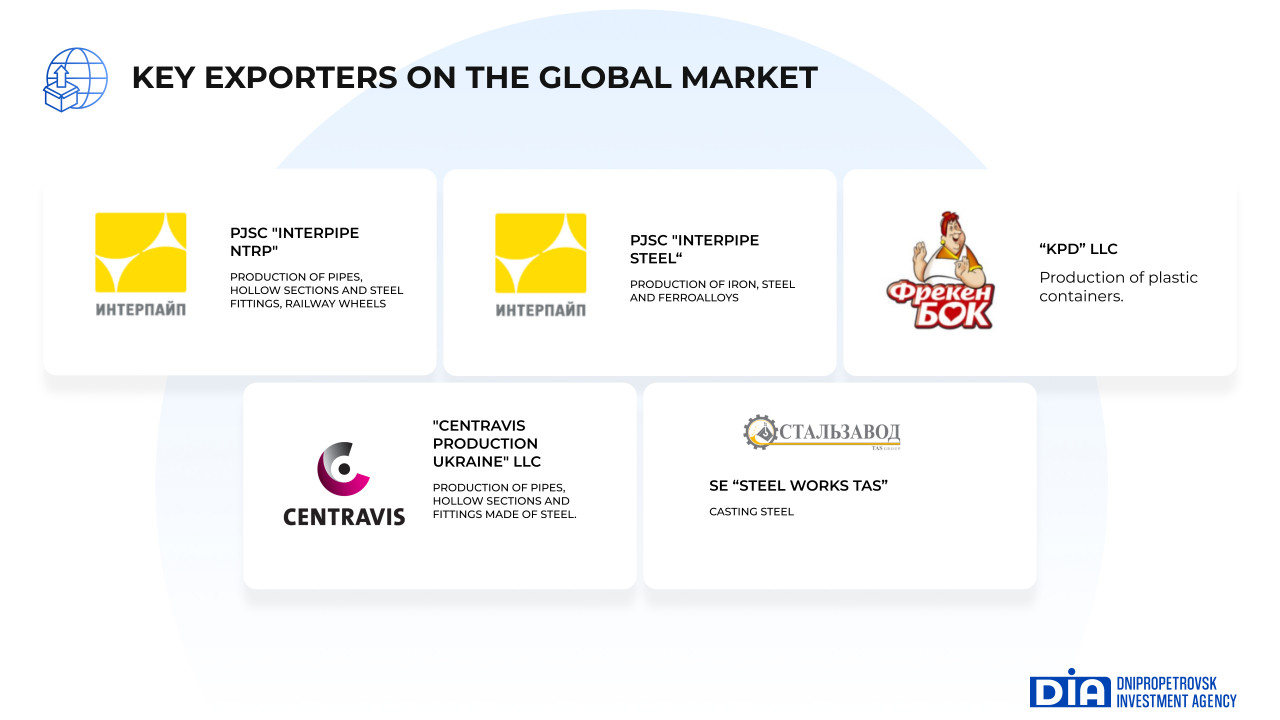
Export operations were carried out by 20 enterprises from Dnipropetrovsk region. The main exporting companies are enterprises of the metallurgical complex, processing industry, and machine-building enterprises.
TOP-5 exporting enterprises (ranked by volume of exported products):
Dnipropetrovsk region remains a key consumer of Slovenian goods in Ukraine: based on the results of 9 months of 2025, it accounted for about 24% of Ukraine’s total imports from Slovenia. The volume of imports into the region amounted to $50.7 million, an increase of 12.9% compared to the corresponding period of 2024. Dnipropetrovsk region traditionally purchased: pharmaceutical products, various chemical products, food products, ferrous metals, machinery and equipment, and other goods.
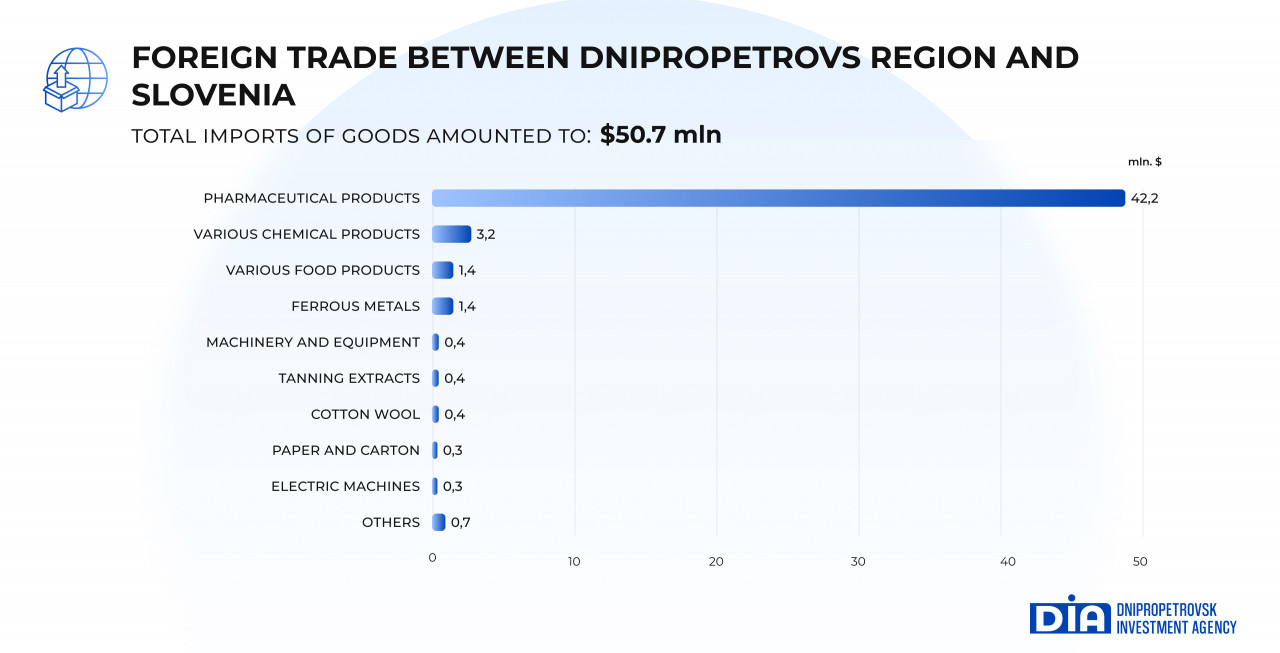
Import operations were carried out by more than 70 importing enterprises.
TOP-5 importing enterprises (ranked by volume of imported products):
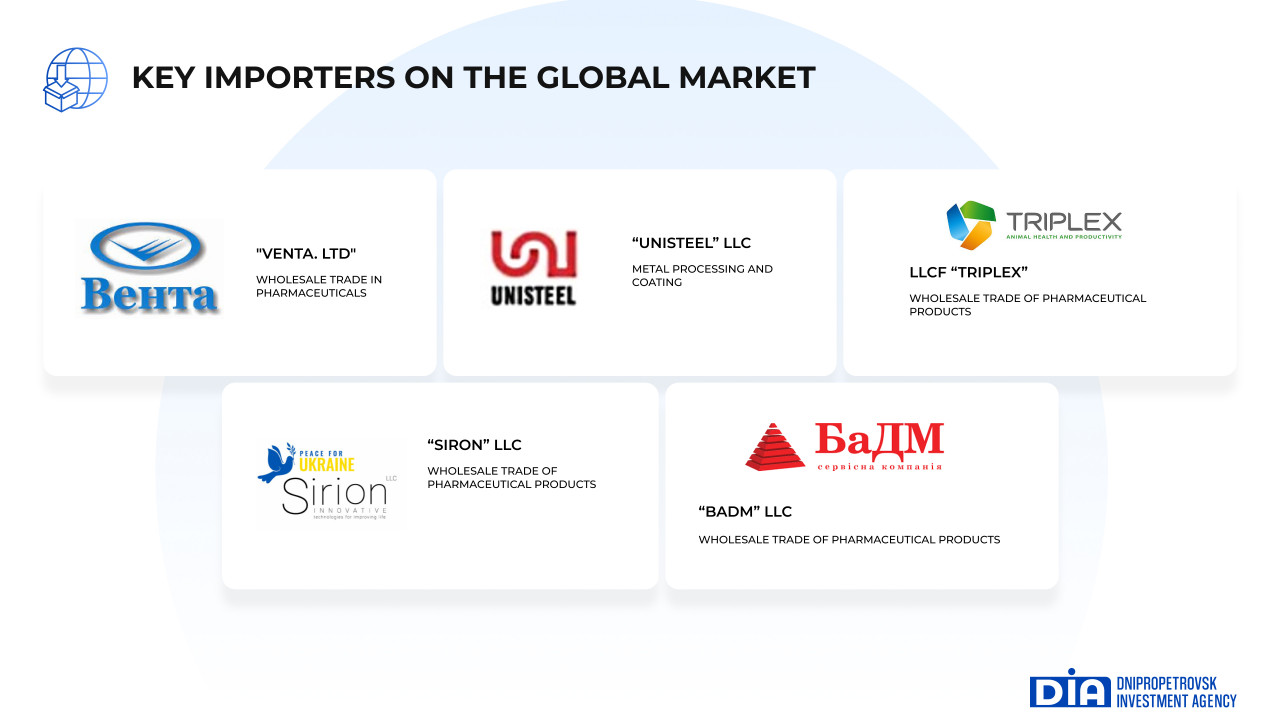
Import operations were mainly carried out by pharmaceutical, trade, metallurgical, processing, and machine-building enterprises.
Source: information for the preparation of this article was taken from open online sources