Dnipropetrovsk Investment Agency (DIA) has prepared an overview of the international cooperation of Ukraine and Dnipropetrovsk region amid the aggression of the russian federation. The material focuses on the support of Republic of Korea and foreign trade indicators based on DIABASE data.
Throughout 2025–2026, the Republic of Korea continued to expand its support for Ukraine, combining political solidarity, financial assistance, humanitarian programs and participation in the preparation of large-scale reconstruction projects. Seoul’s assistance has a distinctly long-term orientation. The Korean side not only responds to the urgent needs of wartime, but also helps to create the foundation for modernizing Ukraine’s transport, energy, medical, educational and municipal infrastructure.
At the political level, the Republic of Korea consistently supports the sovereignty, independence and territorial integrity of Ukraine. Seoul condemned russia’s full-scale invasion, joined international sanctions and export restrictions, and supported key United Nations General Assembly resolutions on Ukraine. Representatives of the Korean government have repeatedly emphasized that changing borders by force and violating international law create a threat not only to Europe, but also to the global security system.
Economic support has become one of the central areas of the Korean-Ukrainian partnership. The main financial instrument is the Economic Development Cooperation Fund (EDCF) of the Republic of Korea. The framework agreement between the governments of the two states provides for the possibility for Ukraine to raise up to $2.1 billion in concessional financing in 2024–2029. At the end of 2024, Ukraine received the first $100 million in budget support aimed at covering social expenditures. Throughout 2025–2026, the parties continued to form a portfolio of projects that may be financed at the next stages of the program.
The Korean assistance model combines long-term concessional loans, grants, technical expertise and the participation of private companies. Potential projects cover transport, energy, medical infrastructure, housing and communal services, industrial modernization and digital management systems. This approach allows Ukraine not only to obtain financial resources, but also to make use of the engineering and technological experience of the Republic of Korea.
In 2025, Seoul launched for Ukraine a four-year Economic Innovation Partnership Program (EIPP) with a total budget of $10 million. The program provides for strategic consulting, the preparation of feasibility studies and the elaboration of up to 25 public and private projects. Funding is directed primarily at pre-investment preparation, which will make it possible to turn promising Ukrainian initiatives into projects ready to attract international capital and to be implemented.
Railway infrastructure has become a separate large-scale area. In March 2026, Ukraine and the Republic of Korea officially began preparing a feasibility study for the construction of a high-speed passenger railway. The project is being implemented with grant support from the government of the Republic of Korea and has a budget of $8 million. The feasibility study will cover an analysis of possible routes, forecasts of passenger flows, technical parameters, economic feasibility and the integration of the future line into the Trans-European Transport Network (TEN-T). The initiative is one of the first practical infrastructure projects being implemented within the Economic Innovation Partnership Program (EIPP), launched by Korea to support Ukraine’s recovery.
The Republic of Korea also supports the Ukrainian private sector and the involvement of Korean business in reconstruction. Korean companies have considerable experience in mechanical engineering, energy, electronics, construction, transport design, the manufacture of medical equipment and digital technologies. The participation of these enterprises may contribute not only to the import of equipment, but also to the creation of joint production facilities, technological exchange and the localization of certain types of products in Ukraine.
The military support of the Republic of Korea is limited in nature due to the specifics of national legislation and Seoul’s traditional approaches to arms exports to states that are at war. Over the past year, Korea has not announced any direct supply of lethal weapons to Ukraine. At the same time, the country provided non-lethal military and protective equipment, vehicles, medical supplies, demining equipment, body armor, helmets and other property.
The Korean government has also kept open the possibility of revising its policy depending on the nature of russia’s military cooperation with the DPRK. Seoul has repeatedly emphasized that moscow’s transfer of advanced military technologies to Pyongyang, or a direct threat to the security of the Korean Peninsula, could affect the format of further assistance to Ukraine. Thus, although Korea has not become a direct supplier of lethal weapons, its policy on the war is gradually acquiring a more pronounced security dimension.
Korea’s participation in humanitarian demining is of practical importance. The assistance includes equipment for the detection and neutralization of explosive ordnance, specialized machinery, protective gear and support for relevant international programs. For Ukraine, where mine contamination covers significant territories, Korean technologies and experience can be used to clear agricultural land, community territories and infrastructure facilities.
Over the past year, the humanitarian assistance of the Republic of Korea covered healthcare, social protection, education, energy resilience and support for communities affected by hostilities. Through the Korea International Cooperation Agency (KOICA), international organizations and private companies, Ukraine received medical equipment, ambulances, specialized vehicles, generators, autonomous energy systems and municipal machinery.
Through UNICEF and other international organizations, the government of Korea supported Ukrainian families during the winter period. The assistance was directed at providing heat and water, repairing district heating systems, delivering social services, providing psychological support to children and assisting vulnerable households. Particular attention was paid to front-line regions, where damage to energy infrastructure is combined with the constant threat of new attacks.
Education has become an important humanitarian area. Korean partners handed over more than 6,000 digital devices for distance learning to Ukrainian pupils. In 2025–2026, the parties discussed the further digitalization of the educational process, the modernization of the All-Ukrainian Online School platform, the creation of modern laboratories and workshops in vocational education institutions, as well as the restoration of damaged educational facilities.
The regional level has become one of the most practical dimensions of Korean assistance. The recovery of communities is carried out, in particular, through joint initiatives of the Republic of Korea and the United Nations Development Programme. The REVIVE program is aimed at the rapid restoration of critical infrastructure, support for municipal services, the restoration of basic services and assistance to the most vulnerable residents of front-line territories. In 2025, Dnipropetrovsk region received a modern C-arm X-ray machine for the Regional Medical Center of Family Health. The equipment makes it possible to perform surgical interventions under real-time X-ray control, shortens the duration of operations and reduces the risk of complications.
The Korean corporation TYM handed over to the region 20 tractors and 20 sets of mounted equipment. The machinery was distributed among ten communities of the region. It is used for municipal needs, the clearing of territories, agricultural work and the restoration of local infrastructure.
One of the schools in Dnipro district received an autonomous energy system capable of operating for up to two days without recharging. Combined with solar panels and inverters, it ensures uninterrupted power supply for the educational institution without the use of fuel. Such assistance is especially important amid attacks on the energy system and regular emergency power outages.
With the support of the government of the Republic of Korea and the United Nations Population Fund (UNFPA), the cities of Dnipro, Kryvyi Rih and Pavlohrad received three inclusive vehicles for mobile teams providing social and psychological assistance. The vehicles are adapted for people with disabilities and are used by psychologists and social workers for visits to those affected and, where necessary, for their transportation to shelters or crisis rooms.
Within the first stage of the global REVIVE initiative, the volume of support for Dnipropetrovsk region amounted to about $1.5 million. The cooperation covered machinery for rescuers and communities, tractors, medical equipment, ambulances, inclusive vehicles and equipment for educational institutions. The region’s leadership also presented to KOICA the projects included in the national DREAM platform and identified further needs in water supply, the equipping of front-line hospitals and the provision of specialized machinery to rescue services.
The Republic of Korea remains an important trading partner of Dnipropetrovsk region. The level of partnership relations is evidenced by a bilateral analysis of foreign activity.
Korean enterprises mostly purchase organic chemicals, cocoa and cocoa preparations, articles of iron and steel, optical instruments and apparatus, and so on. The volume of goods exported from Dnipropetrovsk region amounted to $1.0 million. Compared with the 9 months of 2024, exports from Dnipropetrovsk region decreased by 50%.
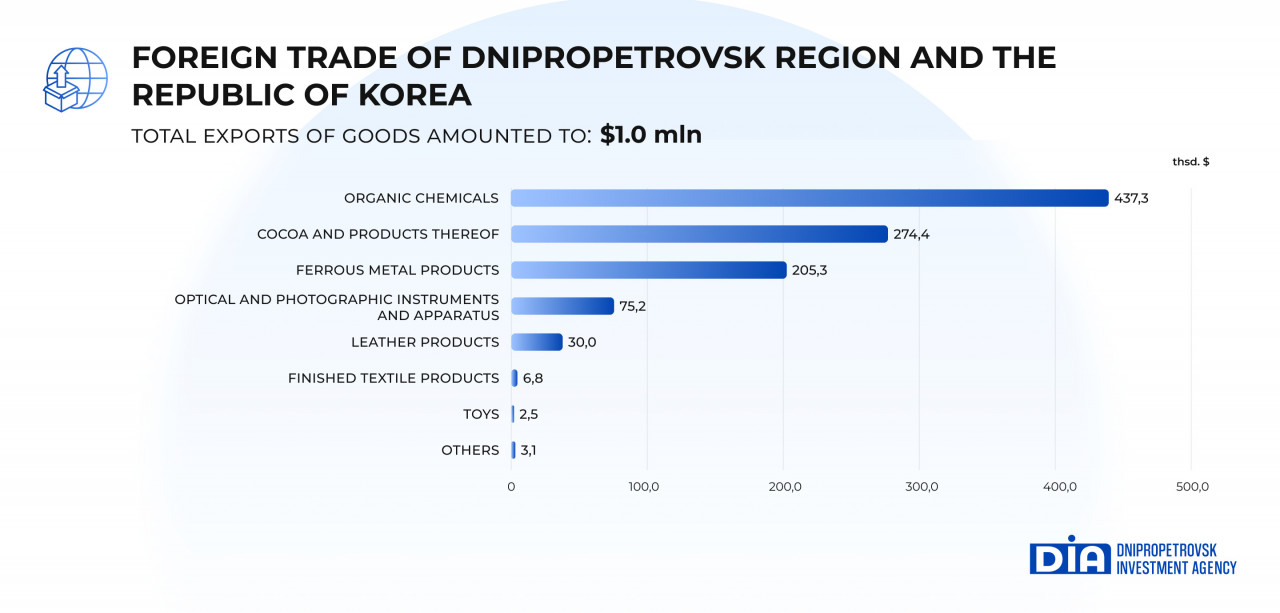
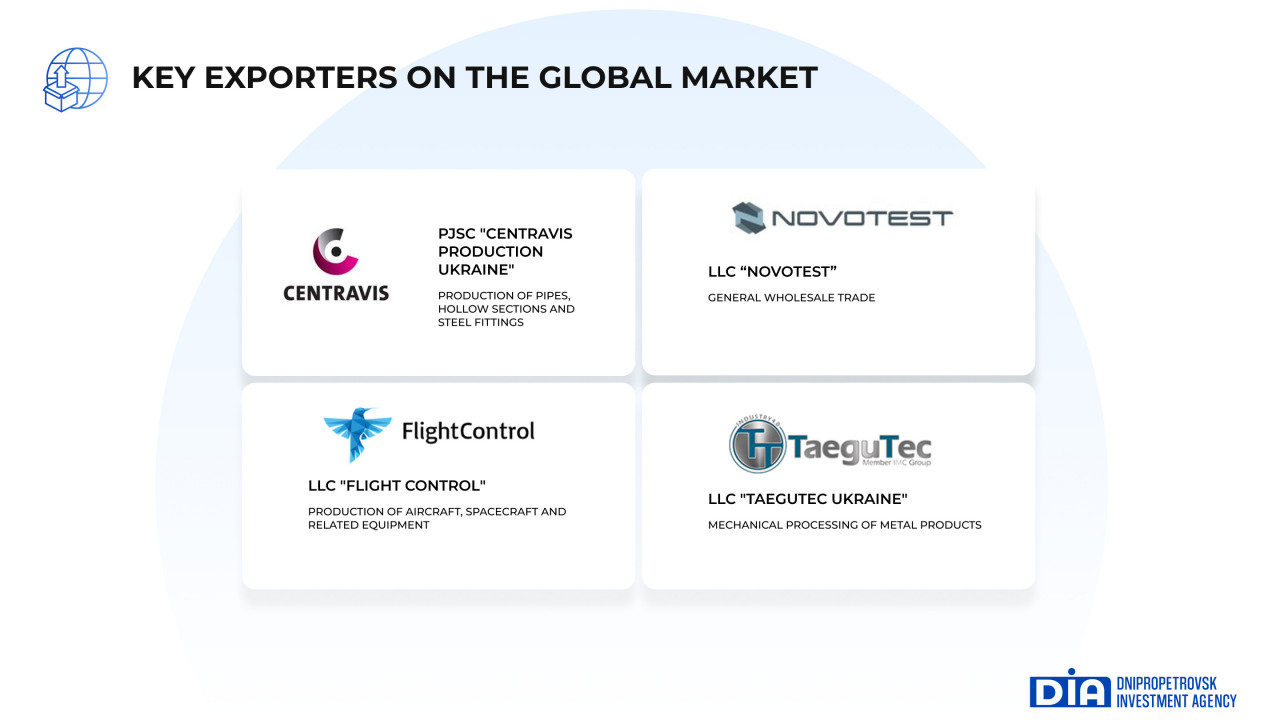
10 enterprises of Dnipropetrovsk region exported their products to the Korean market; these are enterprises of the metallurgical complex, the chemical and processing industries and the agro-industrial complex.
The following enterprises exported their products the most:
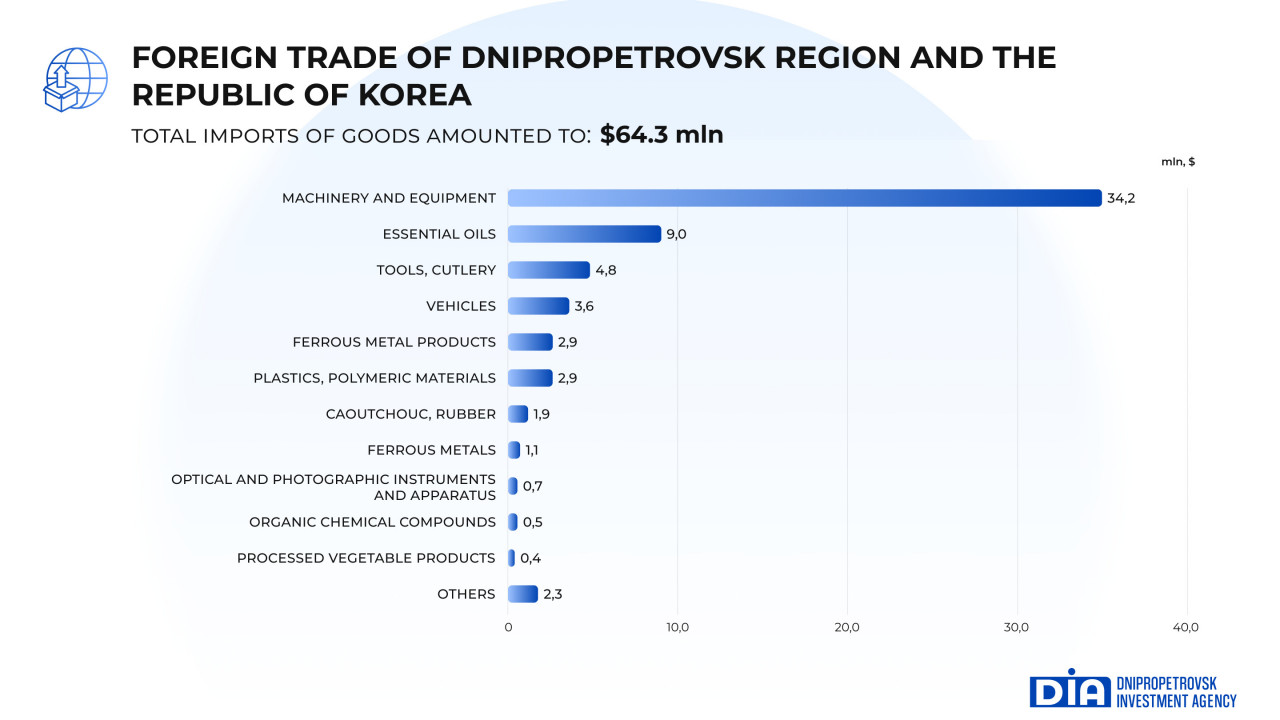
In turn, about 200 importing enterprises of the region mostly purchased Korean goods, namely: machinery and equipment, essential oils, tools, cutlery and others. According to the results of the 9 months of 2025, imports of goods from Korea to Dnipropetrovsk region grew by 13% and amounted to $64.3 million.
The following importing enterprises entered the TOP-5 by volume of imported products:
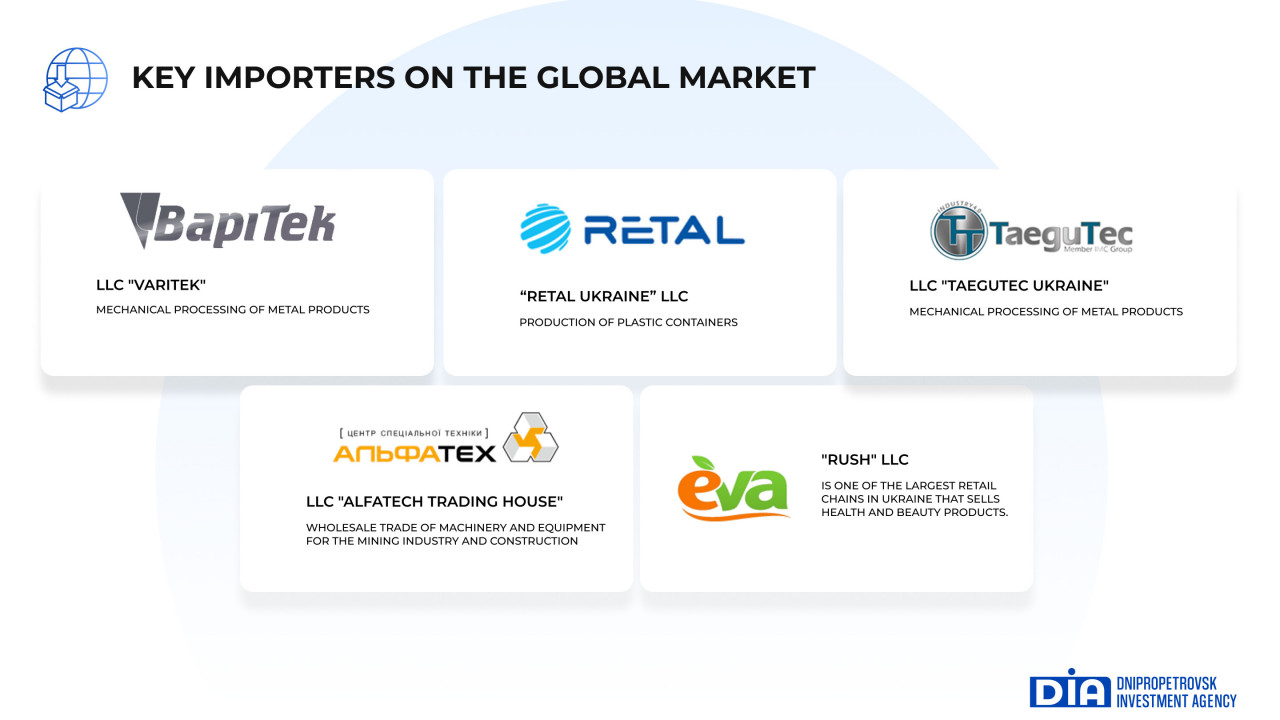
Import operations were mainly carried out by enterprises of the metallurgical and processing industries and by trading enterprises.
Source: information for preparing the article was taken from open online sources and from the website of the Main Department of Statistics in Dnipropetrovsk region.