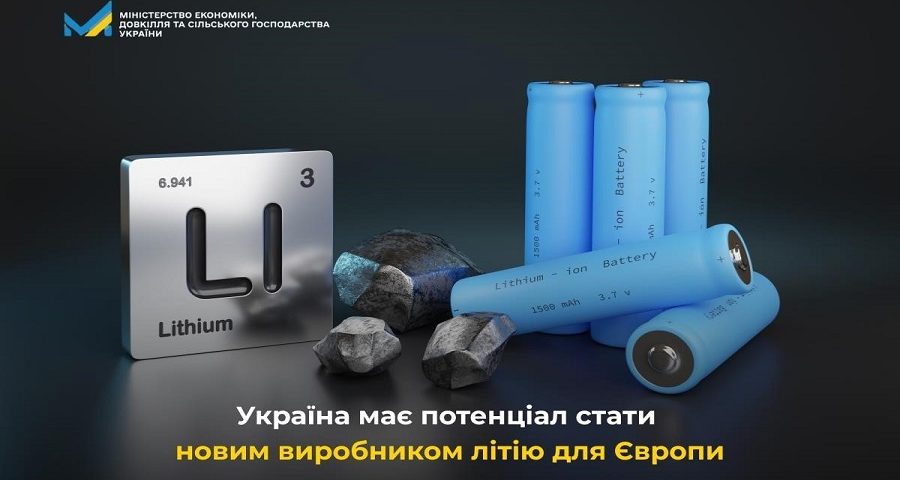
On 12 December, Ukraine closes applications for the first lithium Production Sharing Agreement in its history, for the “Dobra” area. This marks an important step toward building a national critical minerals industry. Against this backdrop, it is essential to assess Ukraine’s potential role in the global lithium market – and the actions needed now to realise it.
The global lithium market is undergoing deep transformation. Over the past five years, lithium has shifted from a material used in narrow segments to a core metal of modern energy infrastructure. After a sharp price spike in 2022 and a correction in 2023–2024, the world is entering a new cycle.
According to IEA’s 2025 outlook, global lithium demand is set to rise from around 205,000 tonnes in 2024 to over 928,000 tonnes by 2040 – an increase of more than fourfold.
The growth of electric mobility, energy storage systems and other clean technologies is driving a stable long-term need for lithium. IEA estimates that demand for lithium in clean tech – primarily for electric vehicles and stationary storage – will rise from 128,000 tonnes in 2024 to more than 369,000 tonnes in 2030.
The trends are clear. That is why sectors related to lithium extraction and processing are expanding globally at an unprecedented pace. Yet despite the large number of announced projects, their combined potential is still insufficient to fully meet future demand. In practice, actual output often falls below declared capacities. The IEA’s 2025 critical minerals outlook shows that even if all currently announced lithium projects come online, the world could face a supply gap of around 40% in 2035 under the Stated Policies Scenario (STEPS).
Another important factor shaping the market is cost structure – and producers’ ability to remain profitable during periods of low prices. Some producers exit the market when prices decline, while those who remain competitive are typically those with low operating costs and manageable debt levels.
For countries entering the sector, this means creating conditions for projects with competitive cost structures and modern processing technologies. For Ukraine, this implies building a development model that positions its future industry within the stable, rather than speculative, segment of the market. It also requires creating effective investment conditions and encouraging the development of new industrial projects.
A further consideration is the current market structure. Today, roughly two-thirds of global lithium processing capacity and more than 70% of battery production are concentrated in China. As a result, global demand will also be driven by consumers’ need – or desire – to diversify supply sources. This opens space for new entrants to secure their niche.
Ukraine has the potential not only to enter the market but to build one of the most successful global examples of such entry. The prerequisites are already in place.
On 12 December, applications close for Ukraine’s first-ever lithium Production Sharing Agreement (the “Dobra” area). Ukraine can develop production based on hard-rock lithium deposits and build a cost-competitive model integrated into European industrial and technological value chains.
To unlock this potential, Ukraine must ensure competitive operating costs, fast and predictable decision-making, technological development, and integration into Western supply chains.
Subject to licensing and compliance with standards, lithium extraction and processing projects may be eligible for consideration as potential candidates for financing through the U.S.-Ukraine Reconstruction Investment Fund.
Ukraine is entering a decade in which critical minerals will determine energy resilience, industrial development and the growth of sectors moving toward electrification. By combining its resource base with technology, investment and rapid decision-making, Ukraine can strengthen its position in the new economy.
Source: https://me.gov.ua