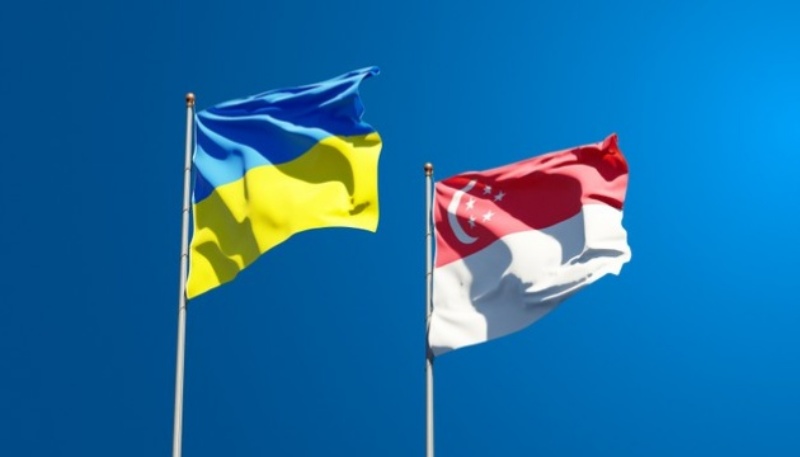
Dnipropetrovsk Investment Agency keeps introducing about the level of Ukraine and Dnipropetrovsk region cooperation with other countries amid the unprovoked military aggression by the russian federation. For now, we propose an overview of the assistance provided by Singapore and the foreign trade volume figures, which is derived from DIABASE data.
Singapore’s assistance to Ukraine combines hard power instruments – including sanctions, financial restrictions, and export controls – with practical, life-saving humanitarian support, such as the provision of ambulances, fire engines, rescue equipment, and procurement via the Red Cross).
For Singapore, which is traditionally cautious regarding unilateral sanctions, the 2022 decision marked an extraordinary step. It served as a clear signal that the violation of sovereignty and the use of force cannot be ‘normalized,’ even in a distant region. Following the Russian invasion, the Singaporean government implemented a restrictive package in two major areas. The first area is export control: bans/restrictions on the supply of goods to Russia that could be directly used as weapons, as well as items that could support offensive cyber operations. The second area is financial measures: targeted restrictions against specific Russian banks/entities and operations that could benefit the Russian state. As a global financial hub, Singapore placed a particular emphasis on a key nuance: digital payment token service providers are strictly prohibited from facilitating the circumvention of these measures.
In June 2024, the President of Ukraine conducted a working visit to Singapore on the sidelines of the Shangri-La Dialogue, holding separate meetings with President Tharman Shanmugaratnam and Prime Minister Lawrence Wong. The discussions focused on a principled stance regarding state sovereignty and territorial integrity, sanctions pressure on the Russian Federation, and the humanitarian consequences of the war. Key emphasis was also placed on engaging Asia-Pacific nations to support a just peace, particularly through international cooperation frameworks. A specific practical outcome was the signing of the Ukraine-Singapore Air Services Agreement (ASA), witnessed by both heads of state during the visit. This document establishes the legal framework for regular and cargo air services, serving as an ‘infrastructural’ signal for the future. In tandem, the Ukrainian side highlighted the economic track: prospects for trade, investment, and agricultural exports, alongside a dialogue with Singaporean investors regarding participation in recovery and rebuilding projects.
From the earliest days of the full-scale Russian invasion, Singapore has also provided Ukraine with humanitarian aid, primarily in the form of practical support for life-saving services, with a focus on enhancing civilian resilience during shelling. Through government channels and in coordination with the Singapore Red Cross, essential supplies were delivered to vulnerable groups and displaced persons, alongside heavy equipment for emergency response. This includes ambulances, firefighting vehicles, rescue and protective gear, medical supplies, and specialized equipment to enhance safety for operations in high-risk zones
Despite the geographical distance, pre-war trade between Ukraine and Singapore was consistently increasing, reaching a peak of $286 million in 2019 (compared to $56 million in 2015). The COVID-19 pandemic and Russia’s full-scale aggression against Ukraine negatively impacted bilateral trade, slightly altering the structure of Ukrainian exports. However, Ukraine’s export growth in 2024 (+178%), compared to the pre-war period, was significant, driven by goods such as sunflower and rapeseed oil, table eggs, barley, wheat, and poultry meat.
Singapore’s investments in Ukraine amounted to $259.4 million, remaining active even throughout the wartime period.
Singapore also continues to be a promising trade partner for Dnipropetrovsk region. The depth of this partnership is reflected in the bilateral analysis of foreign trade activities.
Singaporean businesses primarily purchase poultry eggs, products made from ferrous metals, grain crops, optical and photographic instruments, pharmaceutical products, and more. The export volume of goods from Dnipropetrovsk region amounted to $1.76 million, which represents a 43% increase compared to the previous year.
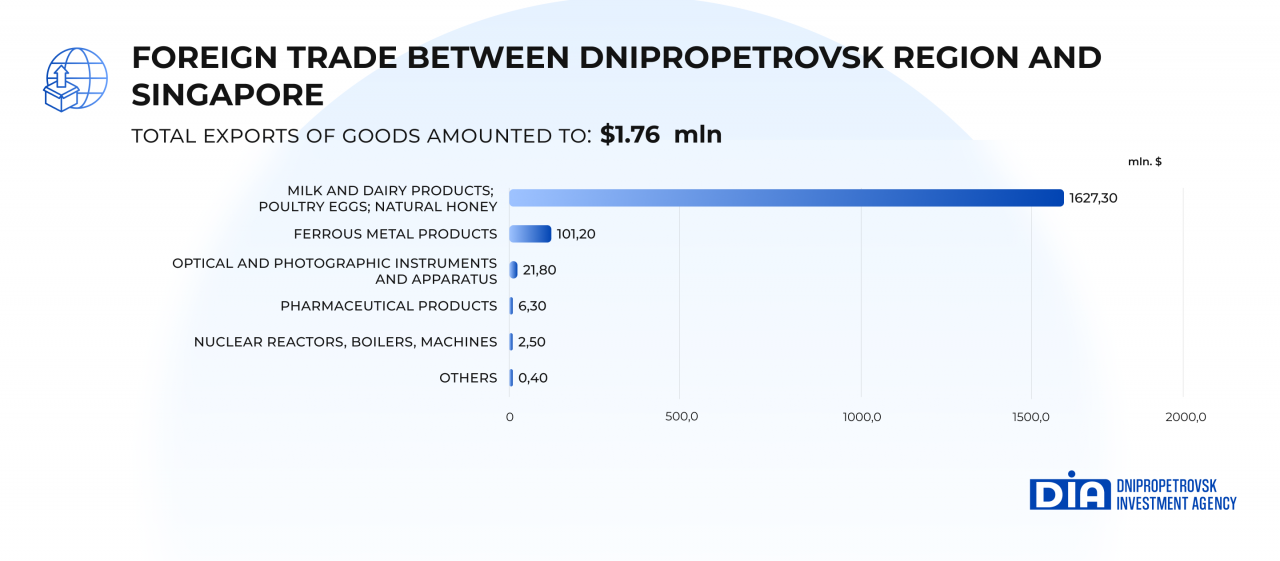
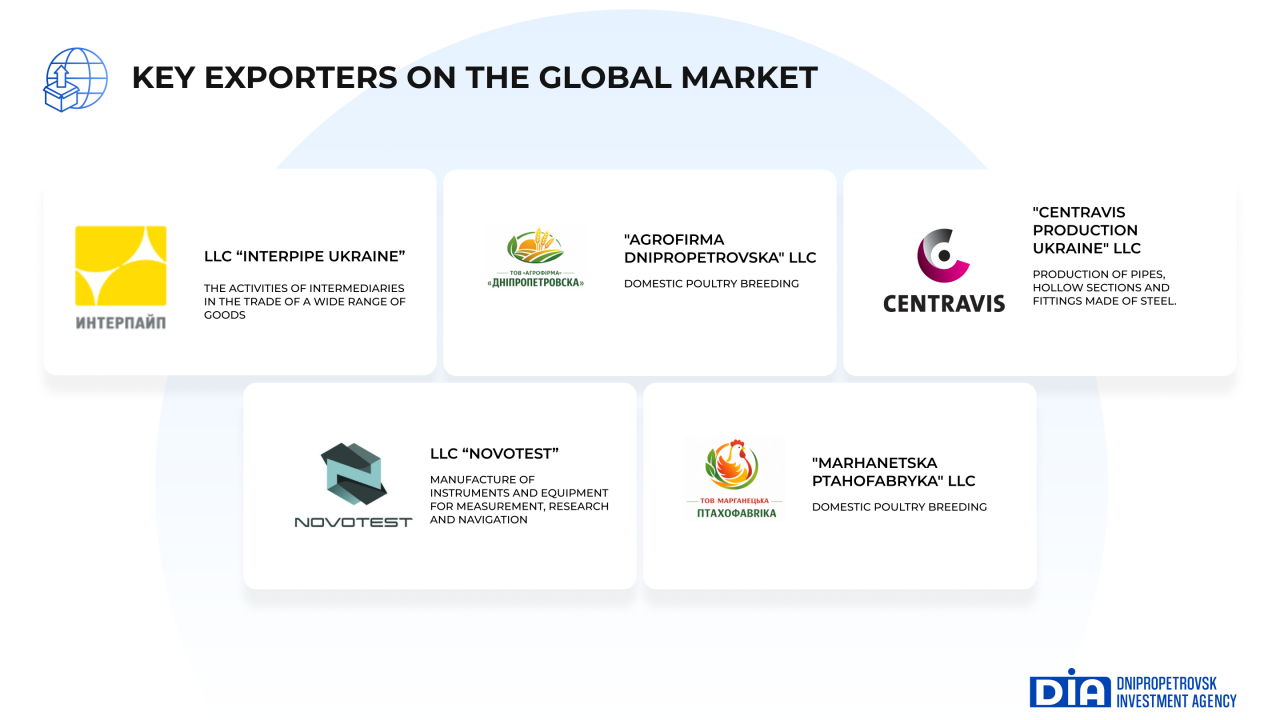
9 enterprises from Dnipropetrovsk region exported their products to the Singaporean market. These enterprises represent the metallurgical complex, agricultular sector, food, and processing industries.
In terms of export volume, the TOP-4 exporting enterprises are the following:
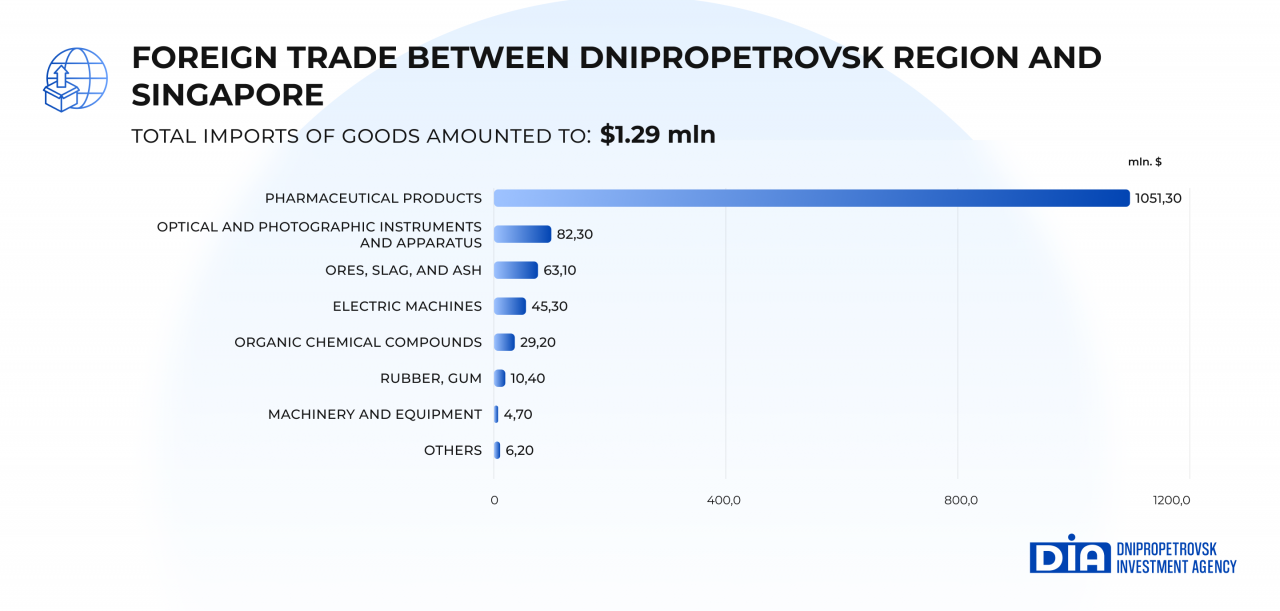
In turn, 30 importers from the region primarily purchased Singaporean goods, including pharmaceutical products, ores, slag, electrical machinery, optical and photographic instruments, and others. The import of goods from Singapore to Dnipropetrovsk region increased by 2.5 times, reaching $1.29 million.
In terms of import volume, the TOP-5 importing enterprises are the following:
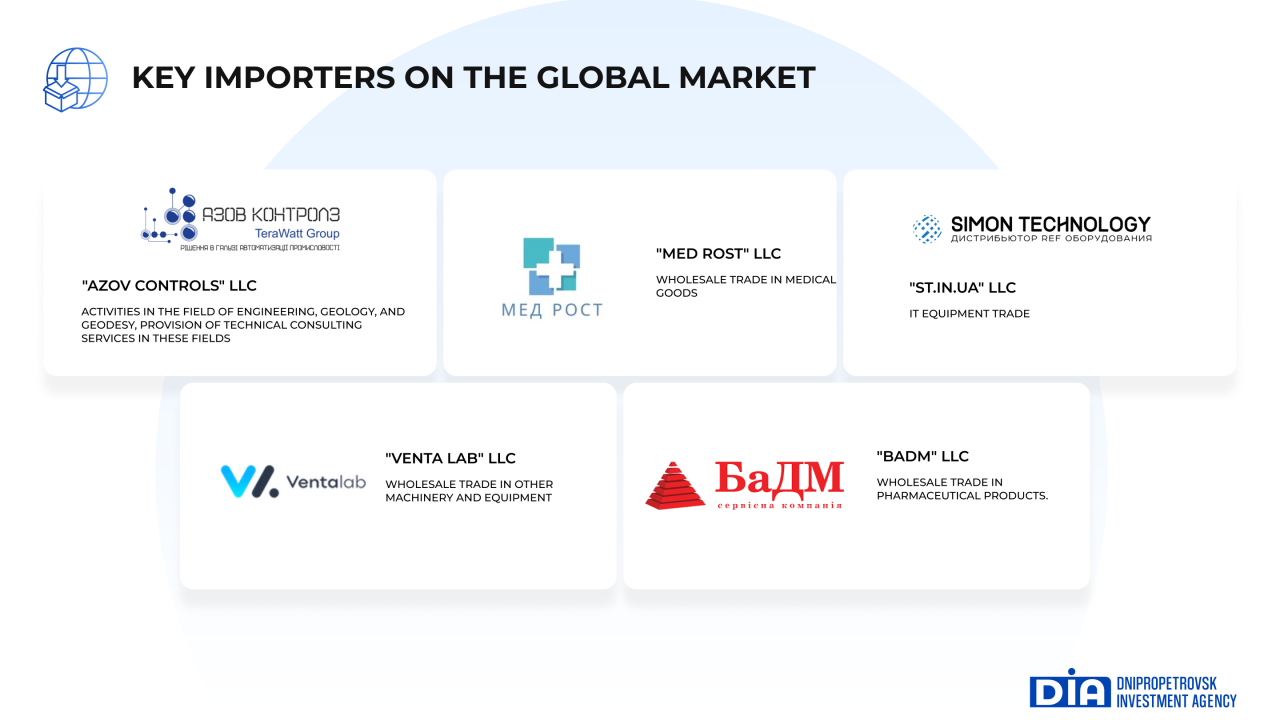
Import operations were primarily conducted by enterprises in the manufacturing and trade sectors.
Source:The information for this article was taken from open online sources.