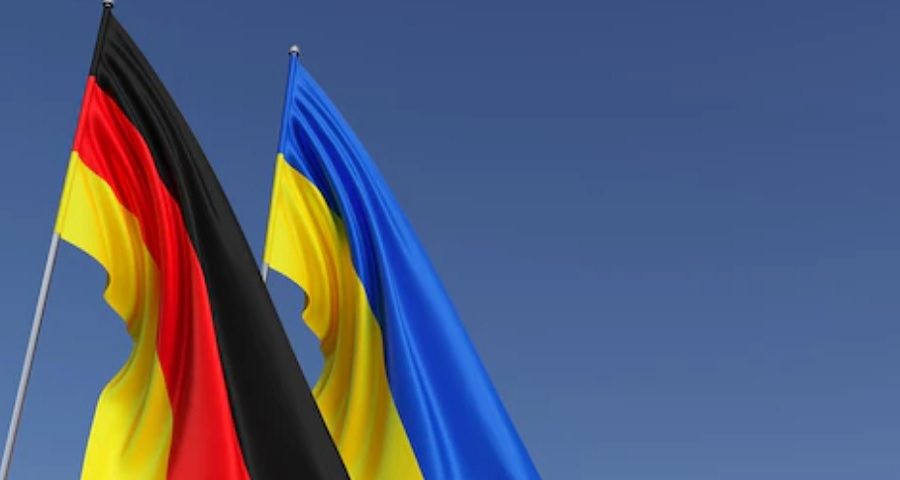
Dnipropetrovsk Investment Agency keeps introducing the level of cooperation between Ukraine, Dnipropetrovsk region and other countries amid the unprovoked military aggression of the russian federation against our state. In this publication, we offer an overview of the support provided by Germany and the volume of foreign trade, based on DIABASE data.
Since the invasion of Russia to Ukraine on 24 February 2022, Germany has provided Ukraine with both civilian support amounting to approximately €39 billion and military support amounting to approximately €55 billion, including air defence systems, artillery and combat vehicles, armoured personnel carriers, small arms, ammunition, medical supplies and protective clothing. In addition, since the beginning of the war, Germany has trained more than 24,000 Ukrainian service personnel in Germany.
Throughout 2025, Germany remained one of Ukraine’s key partners in countering Russian aggression, combining military, financial, humanitarian, energy and political support. At the beginning of the year, during the meeting of the Ukraine Defence Contact Group in Ramstein on 9 January, the Minister of Defence Boris Pistorius confirmed that Berlin would continue to act decisively: in 2025, Germany delivered IRIS-T systems to Ukraine, additional missiles for those systems, continued the training of Ukrainian military personnel with the aim of training an additional 10,000 service members, and, together with Croatia, financed 30 tanks and 30 infantry fighting vehicles.
The Bundestag Budget Committee approved an additional €3 billion in military assistance for Ukraine for 2025. At the same time, the German side earmarked a further €8.252 billion for 2026–2029, thereby establishing a multi-year support mechanism worth more than €11 billion. Another important step was the Berlin meeting on 28 May 2025, following which Germany announced an assistance package of approximately €5 billion. This included financing the production in Ukraine of long-range systems, new deliveries of ammunition, air defence assets and small arms, the provision of satellite and military communications, as well as medical equipment. In this way, German assistance increasingly shifted from a model of one-off deliveries to a model of long-term reinforcement of Ukraine’s defence production capabilities.
The civilian component of German support was no less important in 2025. Through KfW, the Federal Government financed the repair and reconstruction of electricity and heat supply systems, the delivery of spare parts, and the reconstruction of destroyed energy facilities; the German Federal Foreign Office expanded emergency energy assistance, facilitated the supply of turbines and generators, supported the protection of nuclear infrastructure, humanitarian programmes near the front line, medical evacuation, demining, and public information campaigns on mine risks. At the same time, support was provided to Ukraine’s civilian security services, the documentation of war crimes, and work with affected communities. In June 2025, Germany and Ukraine also deepened their municipal partnership, the network of such links grew from 70 to 250, including 10 partnerships between Ukrainian regions and German federal states. In July, at the Ukraine Recovery Conference in Rome, Berlin stressed that recovery cannot be postponed until the end of the war: power plants, electricity transmission lines, hospitals and schools must be restored even during hostilities, and international partners together with the private sector must launch new financing instruments, including the European Flagship Fund for the Reconstruction of Ukraine.
This support reached a new level in April 2026 during intergovernmental consultations and the signing of the declaration on a strategic partnership between Germany and Ukraine. The document recorded the parties’ intention to hold regular consultations on security and defence policy, to develop joint projects in the defence industry, and to strengthen Ukraine’s capabilities in air defence, ammunition, unmanned systems and long-range systems. It also provides for joint work on the production of air defence systems and missiles, accelerating the development of anti-ballistic defence, supporting Ukraine’s drone industry, and establishing joint production facilities.
At the same time, Germany confirmed its readiness to continue supporting medical evacuation, rehabilitation, training programmes for military personnel, the civilian security sector, Ukraine’s energy resilience, as well as accountability mechanisms for Russian aggression, including the Special Tribunal and the international claims commission. Within the same framework, Berlin announced new financing of up to €233 million for industrial recovery, energy resilience, social housing, workforce training, local self-government, anti-corruption measures, and Ukraine’s progress towards EU membership.
Germany also provided support to the city of Dnipro and the communities of Dnipropetrovsk region. In July 2024, the city of Dnipro signed a memorandum with the German agency GIZ. The identified priorities included support for heating and energy systems, assessment of damage to critical infrastructure, housing and social facilities, as well as assistance in recovery and repairs of war-related damage. In 2025, this support took on a very concrete and practical form at the level of the region’s communities. During January and February 2025, with the support of German partners, the Apostolove community received a modular battery storage system for its Administrative Services Centre and a modern mobile clinic, both procured and installed by GIZ under the EU4ResilientRegions programme funded by the Government of Germany.
In addition to targeted assistance, in April 2025 Dnipropetrovsk region hosted the presentation of a just transition project for implemented by GIZ. This is no longer only humanitarian or energy support, but also assistance for the long-term economic transformation of the region’s communities.
The current level of economic relations between Dnipropetrovsk region and Germany may indicate significant growth potential in the area of investment activity. There are 44 German companies operating in the region in industrial manufacturing, trade, logistics, engineering and services, with total investment in the regional economy amounting to $88.2 million. Their activities contribute to the development of the region’s production capacity, job creation, the introduction of modern technologies, and the strengthening of Dnipropetrovsk region’s foreign economic ties.
Germany also remains an important trading partner of Dnipropetrovsk region. In the first nine months of 2025, exports of goods from Dnipropetrovsk region amounted to $147.8 million, a decrease of 10% compared with the corresponding period of 2024. Exports to Germany accounted for 8.2% of the region’s total exports. German companies were primarily interested in ferrous metals and articles thereof, parts of railway equipment, textile clothing, and other goods.
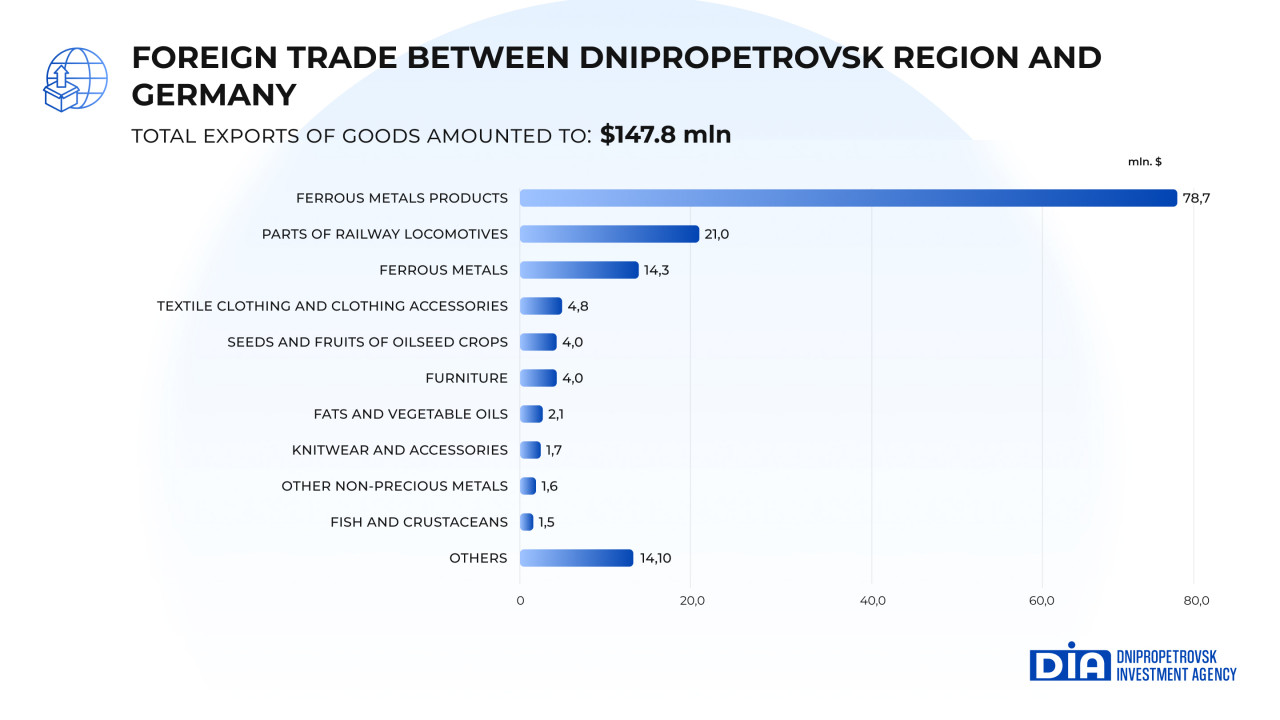
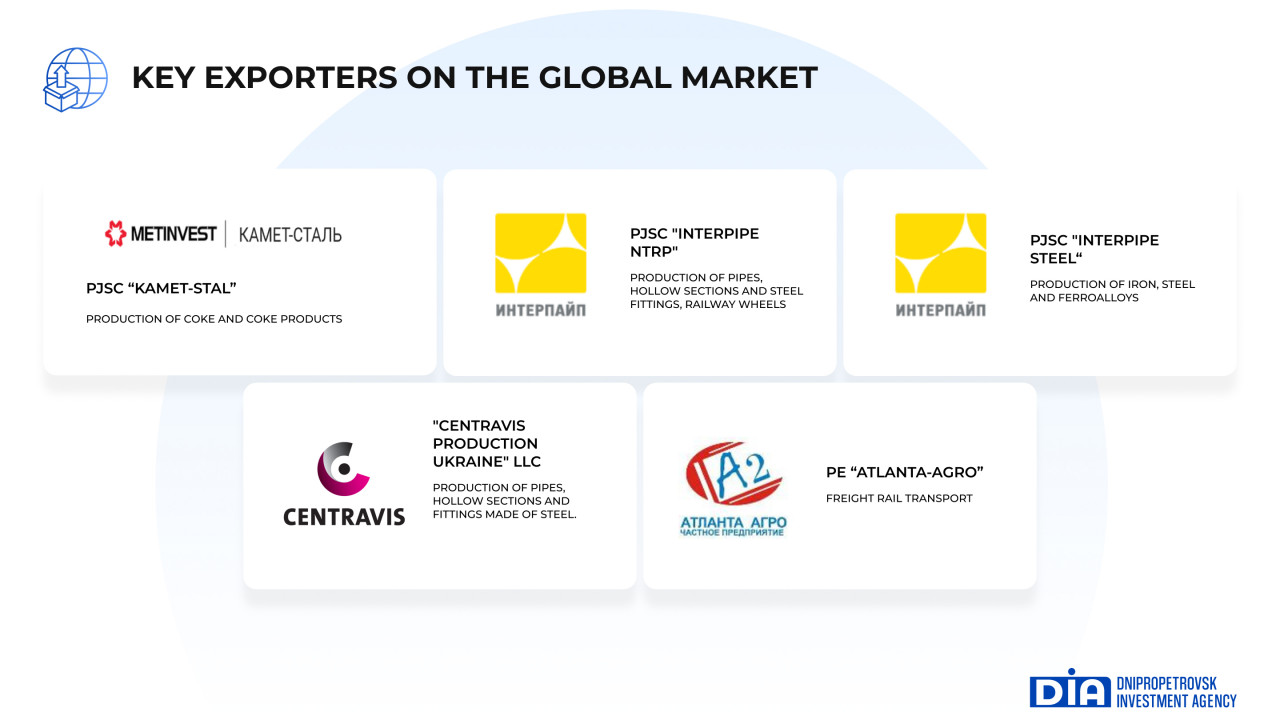
Around 200 enterprises from Dnipropetrovsk region exported their products to the German market, including companies from the metallurgical complex, machine-building, processing industries and agriculture.
Imports of goods from Germany to Dnipropetrovsk region increased by 16.4% compared with the corresponding period of 2024 and amounted to $265.8 million.
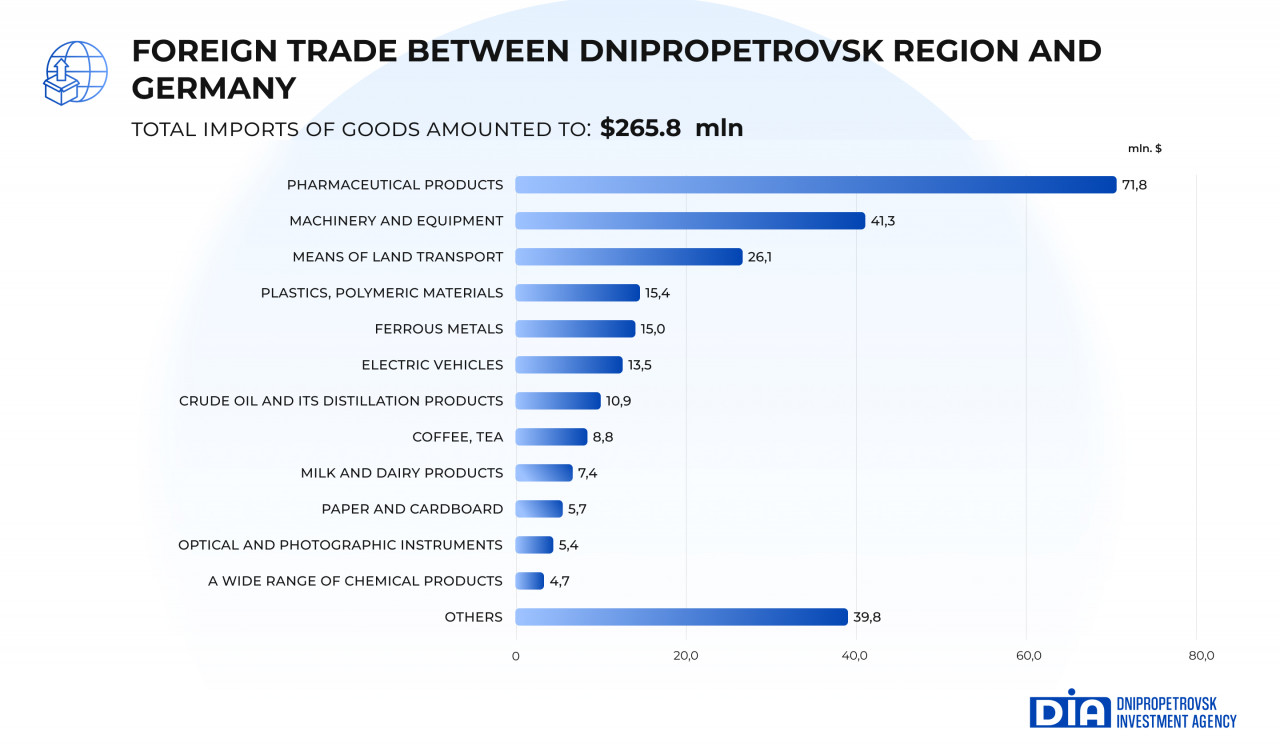
Nearly 700 importing enterprises in the region purchased pharmaceutical products, machinery and equipment, land transport vehicles, plastics and polymer materials, ferrous metals, and other goods.
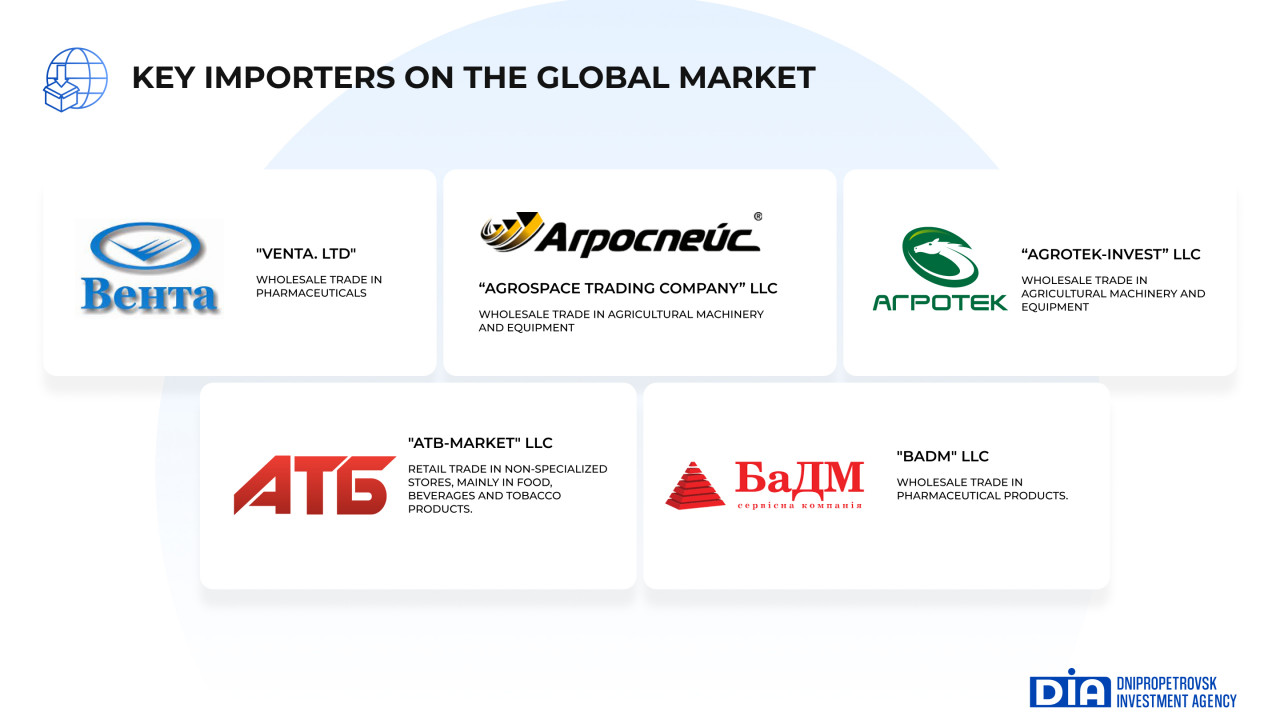
Import operations were carried out mainly by food industry enterprises, processing industry companies, trading companies and pharmaceutical businesses.
Source: the information for this article was taken from open online sources.