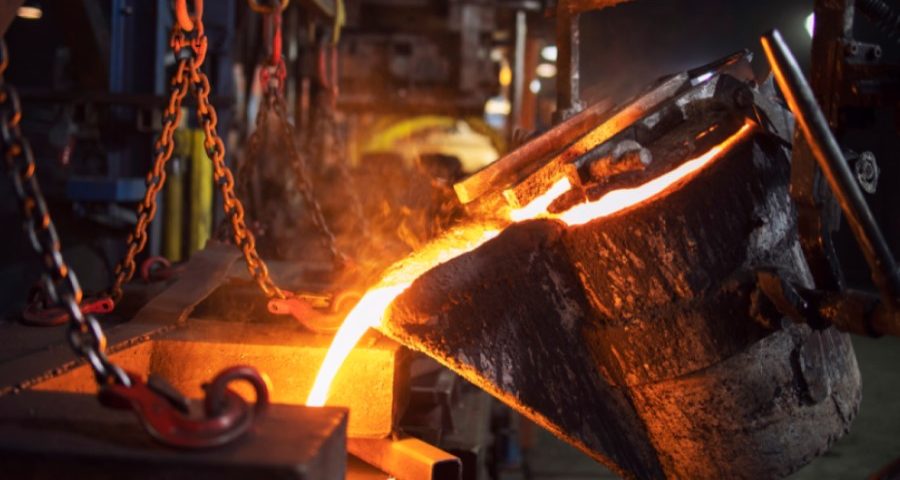
The converter shop at the Kametstal steel mill, part of the Metinvest Group, achieved a record result by extending the service life of the lining in Converter No. 2 by 1,315 smelting runs. With a guaranteed refractory life of 4,500 melts, the actual figure reached 5,815, representing a 29% increase, according to a press release.
The economic benefit from implementing the new technology on just one converter exceeded $440,000.
A key factor was the implementation of a new technology for forming the protective lining, developed by the Refractories and Thermal Engineering Department. It involves switching from the use of raw dolomite to magnesia flux, which improved the uniformity of the protective layer and reduced lining wear.
Previously, dolomite formed an unstable layer, leading to localized burn-throughs, and also required additional firing, increasing energy consumption. The use of magnesia flux made it possible to reduce material consumption by nearly seven times—to about 700 kg per melt instead of 5–6 tons.
The new technology also changed the interaction between the slag and the refractory lining: instead of destroying the refractories, the slag forms a dense protective layer that is securely held on the converter walls throughout the entire operating cycle.
“Our task was to make the lining formation process controllable. Depending on the technical parameters of the melt, the condition of the converter, and the quality of the cast iron, we decide at which stage it is appropriate to introduce the material and in what quantity,” noted Senior Production Foreman Andriy Kovalov.
According to company representatives, laser scanning of the unit’s inner surface has become an additional control tool, allowing for the creation of a 3D model and the precise determination of the protective layer’s thickness.
In this way, the company has managed not only to reduce specific costs but also to extend the time between overhauls and improve the unit’s operational reliability. A similar solution is already being implemented on Converter No. 1.
As a reminder, Kametstal previously launched a program of major overhauls of its main production equipment for 2026. The first major phase was the overhaul of Converter No. 2 in the converter shop.
Source: https://gmk.center