Dnipropetrovsk Investment Agency keeps introducing about the level of Ukraine and Dnipropetrovsk region cooperation with other countries amid the unprovoked military aggression by the russian federation. For now, we propose an overview of the assistance provided by EU and the foreign trade volume figures, which is derived from DIABASE data.
Russian war against Ukraine has become the biggest security challenge for Europe since World War II – and at the same time a test of the ability of the EU to act not only as an economic union, but also as a political and strategic player. From the first days of the full-scale invasion, the support of Ukraine by the European Union has been systematic: from sanctions pressure on the aggressor and financing the work of the Ukrainian state to military, humanitarian, and energy assistance, which is critical for the stability of society under attack.
The EU and its member countries are the largest source of financial support to Ukraine. So far, €104.5 billion has been mobilized for financial, economic, and humanitarian support. This includes:
On the fourth anniversary of russia’s full-scale invasion into Ukraine, a symbolic and practical demonstration of European unity took place in Kyiv: the leaders of EU institutions arrived in the capital—European Commission President Ursula von der Leyen and European Council President António Costa , as well as a number of leaders from Northern and Baltic European countries and partners, including Finnish President Alexander Stubb and the prime ministers of Denmark, Estonia, Iceland, Latvia, Norway, Sweden, and Croatia. The visit was timed to coincide with joint events in Kyiv (including coordination meetings), and emphasized a key message: EU support for Ukraine in 2026 remains not only financial and military-technical, but also political — as a guarantee that Ukraine will not be left alone in the war and on the path to a just peace.
Since the start of the full-scale invasion, the EU has held to one main principle: Ukraine must have predictable funding for salaries, pensions, critical expenditures, and reconstruction, even when the war is hitting the tax base and defense spending is rising. The Ukraine Facilities, a tool for 2024–2027 with a total volume of up to €50 billion, has become the basic “anchor,” providing stable financing for reforms and recovery. As of February 23, 2026, €36.8 billion had been mobilized under the Ukraine Support Program.
To cover the needs of 2026–2027 specifically, EU leaders agreed on December 18, 2025, to a €90 billion loan, which the European Union will raise on capital markets and guarantee with the EU budget; on February 4, 2026, the Council agreed on its position on the legal basis for granting the loan. Under the proposed framework, the EU will provide Ukraine with funding in two ways:
Between 2022 and 2025, the EU and its member states have collectively allocated more than €4.7 billion to help civilians affected by the war in Ukraine, including €3.4 billion from member states and €1.3 billion from the EU. Through UN agencies, international non-governmental organizations, and the Red Cross movement, the EU provides food, water, medical care, shelter, education, and cash assistance.
In 2025, the EU continued to do what has an impact not in the headlines but in capabilities: support through the European Peace Facility (EPF), procurement/compensation, and large-scale training of Ukrainian military personnel. At the EU level, funding for the EUMAM Ukraine training mission was officially recorded: as of November 15, 2025, the amount of support reached €610 million (covering the costs of training and providing training equipment).
At the same time, in 2024-2025, the EU established a mechanism for using windfall profits from frozen Russian assets to support Ukraine. Through the EPF, €3.3 billion was allocated for 2024-2025 to accelerate the production of Ukrainian military equipment (artillery, air defense, drones, etc.), and this logic continued to influence support instruments in 2025-2026.
In 2025 and early 2026, the EU’s sanctions policy remained one of the key ways to raise the price of war for Russia: by restricting access to finance, technology, logistics, and markets. The European Commission maintains a consolidated list of sanctions, which the EU has been expanding since 2014 and significantly strengthened after February 24, 2022. According to reports from late 2025, the 19th package of sanctions was adopted in October 2025, and the 20th package was being prepared for the anniversary of the invasion in February 2026; at the same time, further steps regarding energy restrictions on Russia were being discussed.
After waves of Russian attacks on energy infrastructure in the winter of 2025–2026, the EU stepped up its support so that Ukraine could quickly repair its networks, maintain the system during peak loads, and keep critical services (water supply, heating, hospitals, transport) running continuously. At the European policy level, this is formalized as a separate area of support for Ukraine—energy security and infrastructure—which covers not only the supply of equipment and materials for emergency restoration work, but also strengthening the resilience of the system: backup solutions, modernization of hubs, coordination of repairs, and integration with European networks.
In February 2026, European institutions publicly announced a €920 million package to stabilize the Ukrainian energy system and prepare the Winter Energy Plan 2026–2027. The logic is simple: quick repairs, equipment, reserves, and donor coordination for winter risks.
The EU is an important trading partner for Dnipropetrovsk region. The high level of partnership is evidenced by a bilateral analysis of external activities.
According to the results of 2024, the volume of exports of goods from Dnipropetrovsk region decreased by 4.2%, amounting to $3,275.2 million. Among the goods that are in the highest demand among European consumers are ores, slags, ferrous metals and products thereof, products of plant origin, fats and vegetable oils and others.
The export volumes of the following products increased significantly:
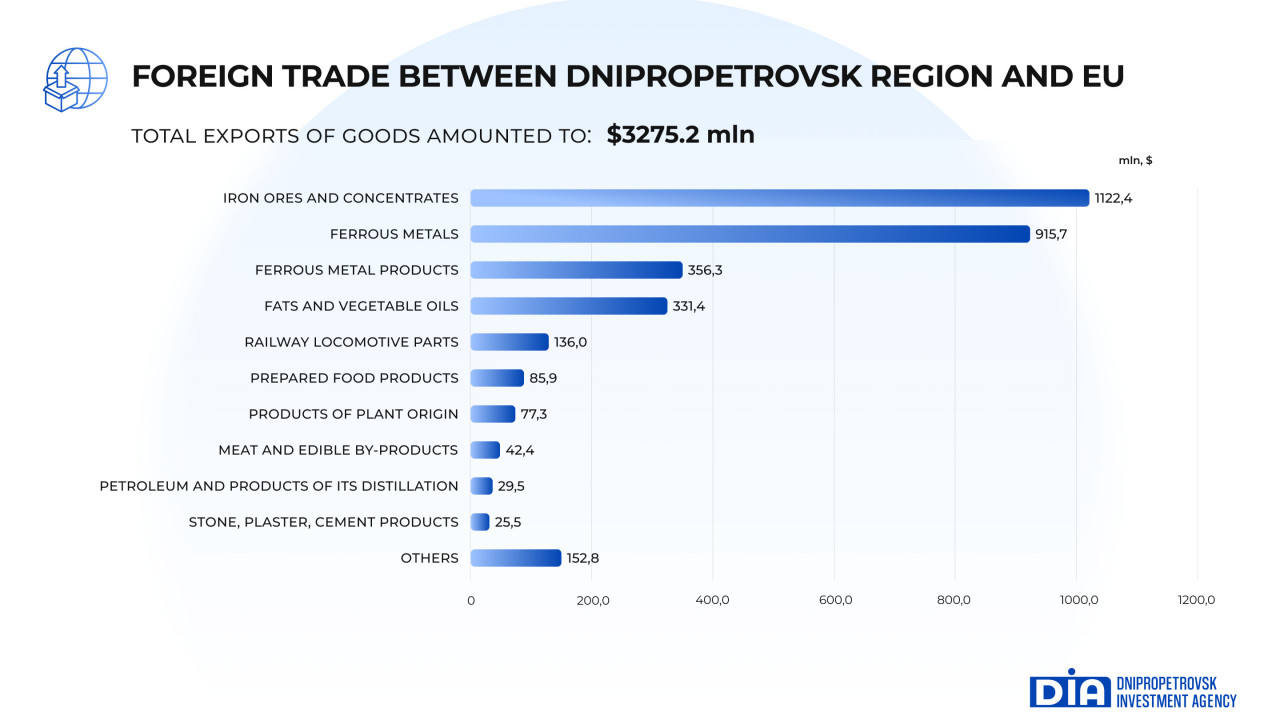
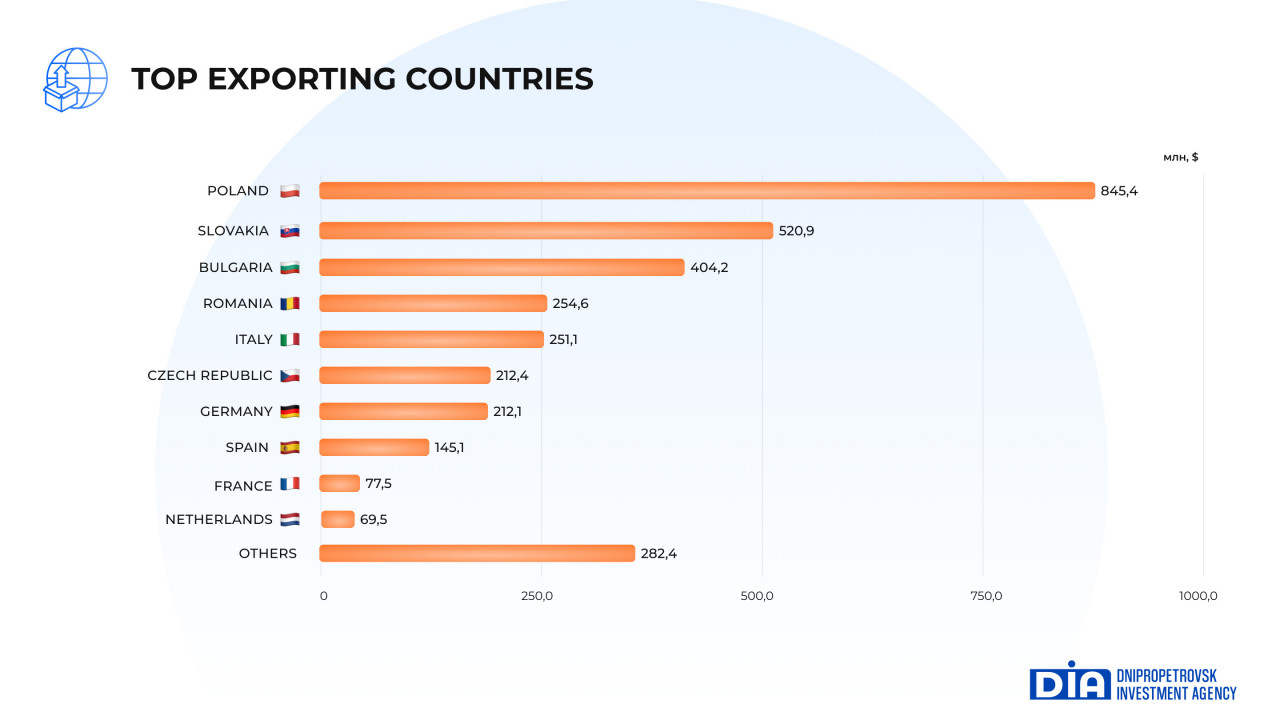
Poland, Slovakia, and Bulgaria became the leaders among EU member states that are consumers of Ukrainian goods.
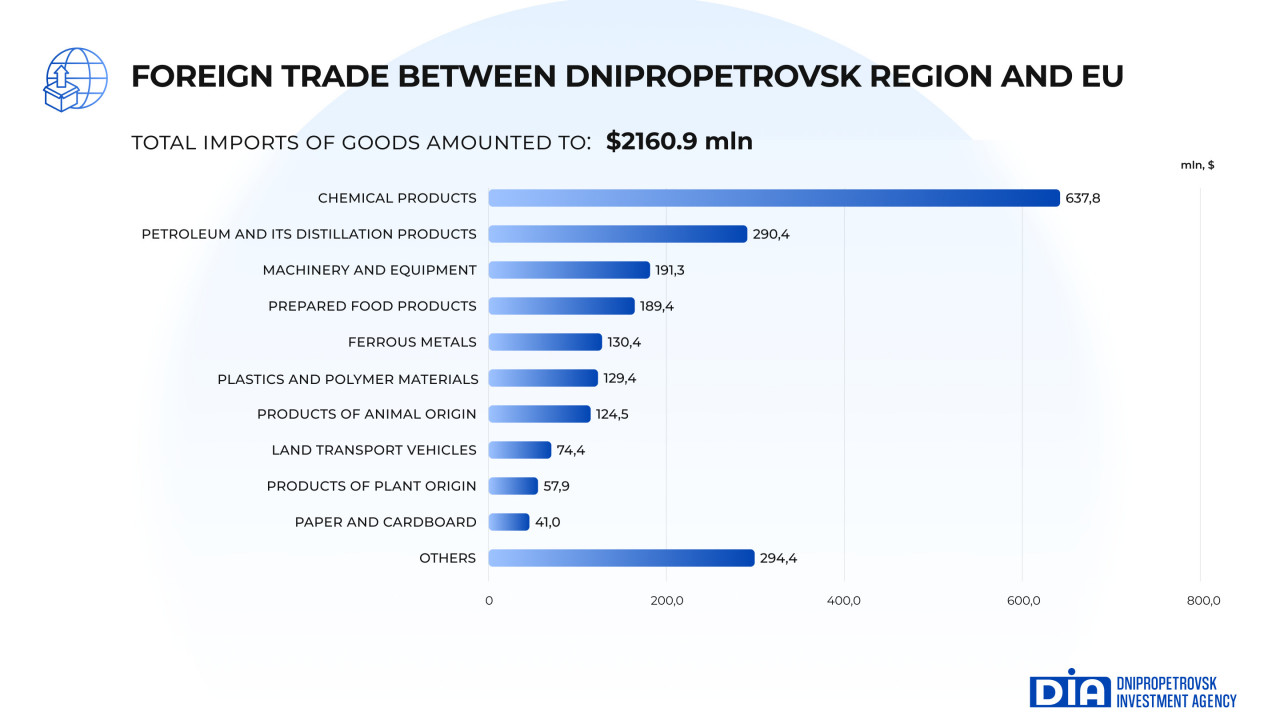
Imports of goods from the EU in 2024 amounted to $2,160.9 million, an increase of 13% compared to the previous year. Dnipropetrovsk region purchased the most chemical products, mineral products, machinery and equipment, prepared food products, plastics and polymer materials and others.
Compared to 2023, import volumes increased significantly, in particular:
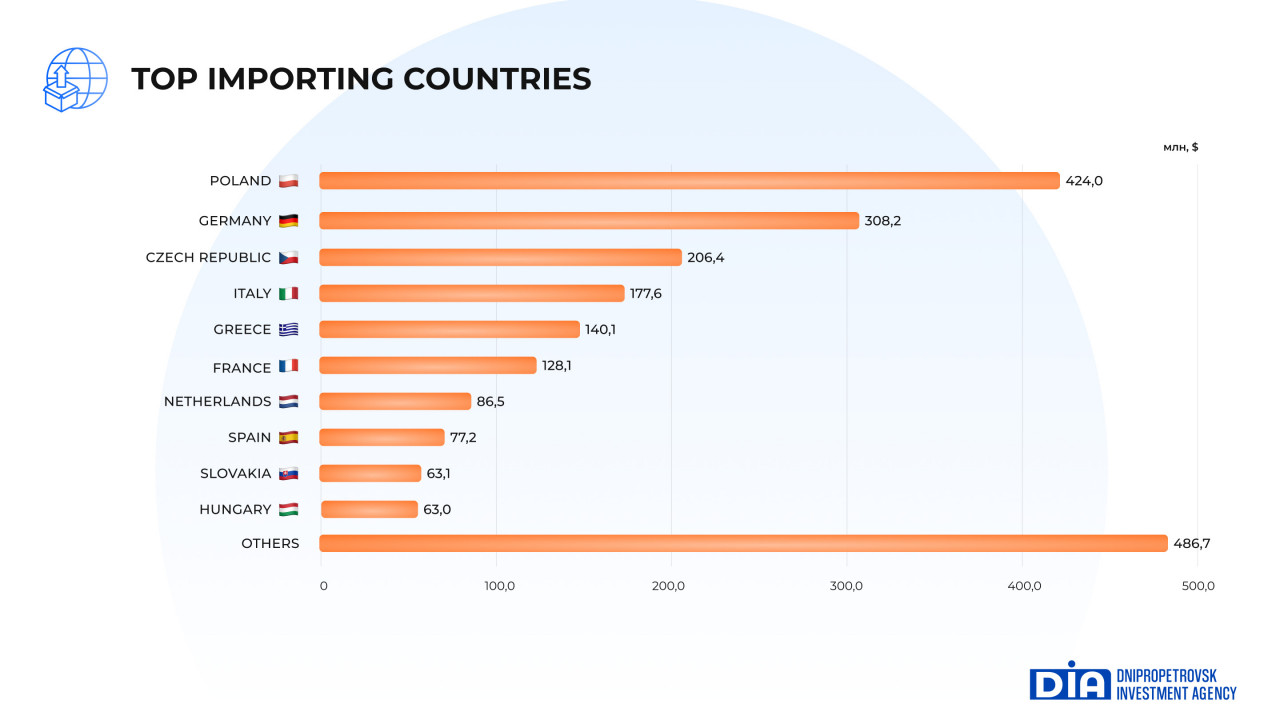
The leaders among the countries whose products were most purchased by Dnipropetrovsk region are Poland, Germany, and the Czech Republic.
Source: the information for this article was taken from open online sources.