Dnipropetrovsk Investment Agency (DIA) has prepared an overview of the international cooperation of Ukraine and Dnipropetrovsk region amid the aggression of the russian federation. The material focuses on the support of Switzerland and foreign trade indicators based on DIABASE data.
Throughout 2025–2026, Switzerland continued to support Ukraine, combining humanitarian aid, economic recovery, support for reforms, humanitarian demining and diplomatic efforts. A distinctive feature of the Swiss model is its long-term nature. Assistance is gradually shifting from responding to urgent wartime needs to systemic participation in reconstruction, the modernisation of infrastructure and the creation of conditions for the development of the Ukrainian economy.
As of the end of 2025, the total volume of support that the Swiss Confederation had provided to people affected by the war in Ukraine — both directly in Ukraine and on the territory of Switzerland itself — amounted to approximately CHF 6.08 billion ($7.48 billion). This sum includes humanitarian and economic programmes, assistance to Ukrainians who have received temporary protection status in Switzerland, funding for international cooperation and other measures of the federal government.
Switzerland’s political position over the past year has remained consistent: Bern supports the sovereignty, independence and territorial integrity of Ukraine and condemns russian aggression as a violation of international law and the UN Charter. At the same time, Switzerland retains its traditional status as a neutral state, which determines the specific character of its participation in supporting Ukraine.
Switzerland continued to align itself with the European Union’s sanctions against russia. In 2025 it implemented the new restrictions provided for by the EU’s 17th sanctions package, in particular with regard to representatives of the russian military-industrial complex, companies, goods of military and technological purpose, and vessels of the so-called shadow fleet. In February 2026, the Federal Council introduced additional EU sanctions measures, and in May it expanded the sanctions lists. At that point, the freezing of assets in Switzerland applied to approximately 2,600 natural and legal persons connected with the situation in Ukraine.
An important political direction remains support for reforms and Ukraine’s European integration. Switzerland is not a member of the European Union and, accordingly, does not take part in the formal decision-making process regarding Ukraine’s membership. At the same time, its programmes are aimed at strengthening democratic institutions, decentralisation, good governance, development of the financial sector and improving the competitiveness of the Ukrainian economy. A separate objective of the Swiss programme is defined as improving the quality of Ukrainian exports and facilitating access for Ukrainian enterprises to the EU single market.
The central event in shaping the new model of assistance was the approval by the Federal Council on 12 February 2025 of the Ukraine Support Programme for 2025–2028. It launched the first phase of a twelve-year strategy to support the recovery, reforms and sustainable development of Ukraine. For the entire period 2025–2036, Switzerland plans to allocate CHF 5 billion (approximately $6.15 billion), of which CHF 1.5 billion ($1.85 billion) is envisaged for the first phase up to 2028. The main priorities are defined as economic recovery, the development of public services and governance, as well as the protection of the civilian population and the promotion of peace.
The economic component of this Programme is of particular importance. Switzerland plans to support Ukrainian small and medium-sized enterprises, private sector development, agriculture, the financial system and the restoration of urban infrastructure. Considerable attention is paid to front-line and the most affected regions, where it is necessary simultaneously to restore basic services and to create economic opportunities for the population.
A separate instrument of cooperation is the involvement of Swiss business in Ukraine’s reconstruction projects. For these purposes, the Programme for 2025–2028 has earmarked $615 million. This concerns primarily energy infrastructure and energy efficiency, water supply and water treatment, transport, and housing and social infrastructure.
In August 2025, during a visit of a government delegation to Switzerland, the parties announced the results of the first competitive selection. Twelve projects of Swiss companies were selected in the fields of energy, housing, public transport, healthcare and humanitarian demining. Swiss co-financing of these projects amounts to approximately CHF 93 million ($114.4 million), while their total value exceeds CHF 112 million ($137.76 million).
This mechanism differs fundamentally from traditional donor assistance. Swiss companies must have a legal presence in Ukraine, and the solutions they propose must correspond to the specific needs of the Ukrainian side. In this way Switzerland seeks to combine state financing with technologies, engineering expertise and private investment.
In 2026 this approach was substantially expanded. In April, Switzerland announced a new call for projects to restore public infrastructure with a total funding volume of up to CHF 150 million ($184.5 million). Priority was given to renewable energy and energy efficiency, water supply and sanitation, housing, public transport, hospitals, schools and agriculture. An individual project may be allocated from $3.69 million to $36.90 million.
In May 2026, another call was opened, this time for investment projects aimed at creating or restoring production capacities directly in Ukraine. The federal government provided for up to CHF 50 million ($61.5 million) for it. The amount of state co-financing per project will range from $3.69 million to $12.30 million, with the company required to provide at least half of the necessary investment from its own funds. This is in effect already an instrument for stimulating long-term private investment, rather than merely financing emergency recovery.
Because of its neutral status, Switzerland does not supply lethal weapons to Ukraine. That is precisely why its security assistance differs substantially from the support of such partners as Germany, the United Kingdom or France. The main emphasis is placed on the protection of the civilian population, humanitarian demining, civil protection, the work of rescue services and dealing with the consequences of hostilities.
One of the largest-scale areas is humanitarian demining. Switzerland has allocated CHF 100 million ($123 million) for these purposes for 2024–2027, becoming one of the leading international donors in this field. Half of the funding is provided by the Federal Department of Foreign Affairs, the other half by the Federal Department of Defence, Civil Protection and Sport.
Swiss assistance covers not only the direct clearance of territories. It includes the transfer of specialised machinery for mechanised demining, equipment and spare parts, the training of Ukrainian specialists, the development of a mine action management system, the mapping of contaminated territories and assistance to victims of explosive ordnance. The implementation of the programmes involves the Swiss foundation Fondation suisse de déminage, the Geneva International Centre for Humanitarian Demining, the company Global Clearance Solutions and other partners.
Demining is directly linked to economic recovery. One of the Swiss projects, with a budget of CHF 10 million, is aimed at returning agricultural land to economic use in Kharkiv, Mykolaiv and Kherson regions. The project is being implemented in cooperation with the World Food Programme and the FAO and is intended to help farmers and rural communities restore production after the clearance of territories.
In 2026, Switzerland continued to strengthen the capacity of the State Emergency Service of Ukraine and the National Police in the field of humanitarian demining. The new projects provide for the supply of equipment, spare parts, technical support, training and logistics, with priority given to front-line and the most affected regions.
Humanitarian aid remains another major area of Swiss support. It is oriented primarily towards internally displaced persons, people returning to liberated communities, and the population of territories close to the front line. Assistance includes material support, provision of basic needs, restoration of access to water, heating, electricity and medical services, as well as support for local humanitarian organisations. For 2026–2027, approximately CHF 4.46 million ($5.49 million) has been earmarked for the flexible emergency humanitarian response mechanism alone.
An important area remains support for Ukrainian institutions and local self-government. Switzerland has worked in Ukraine for many years in the fields of decentralisation, community development, vocational education, healthcare and energy efficiency. After the start of the full-scale war, these programmes were adapted to recovery needs. Particular attention is paid to ensuring that Ukrainian communities have sufficient managerial capacity to plan reconstruction independently, attract investment and manage restored infrastructure.
The development of mutually beneficial trade and economic cooperation also remains an important priority for the two countries. An analysis of the export and import operations of the Dnipropetrovsk region with the Swiss Confederation demonstrates a high level of partnership relations, since this state is an important trading partner of the region.
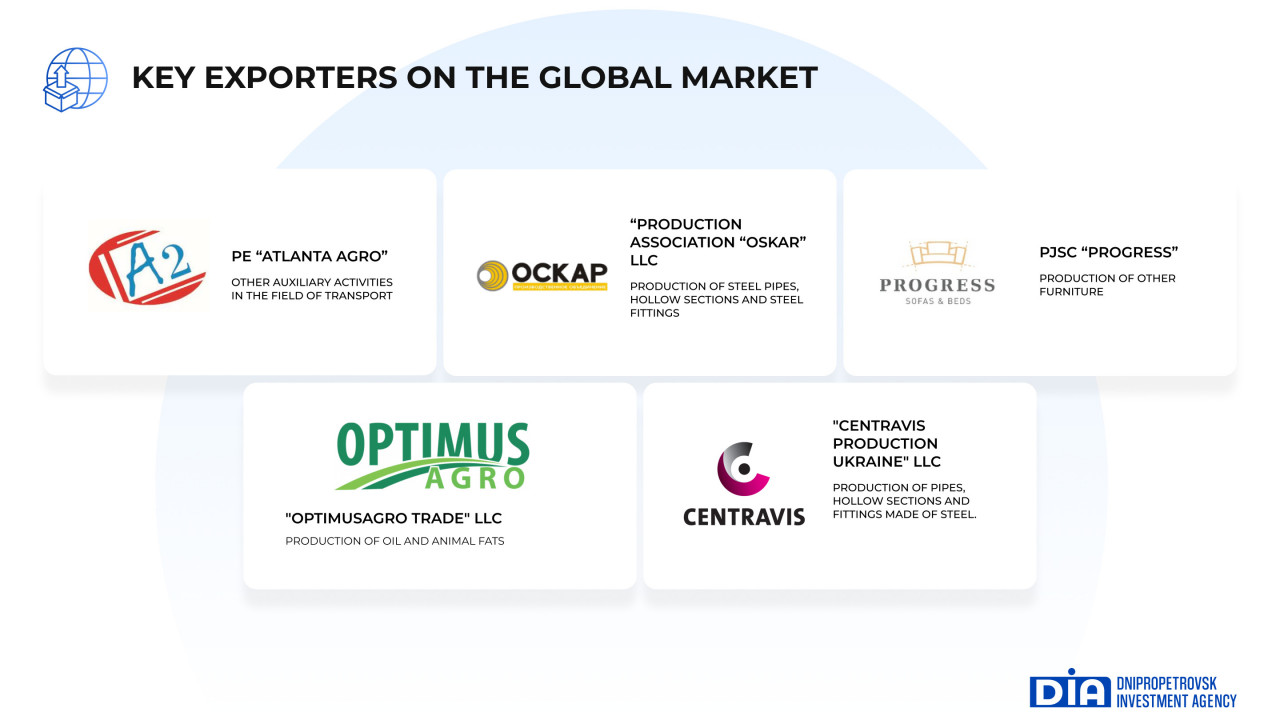
Based on the results of 9 months of 2025, the volume of exports of goods from Dnipropetrovsk region amounted to $3.3 million and increased by 1.8% compared with the previous period. Among the goods in demand among Swiss consumers are articles of ferrous metals, furniture, meat and edible offal, wood and articles of wood, and others.
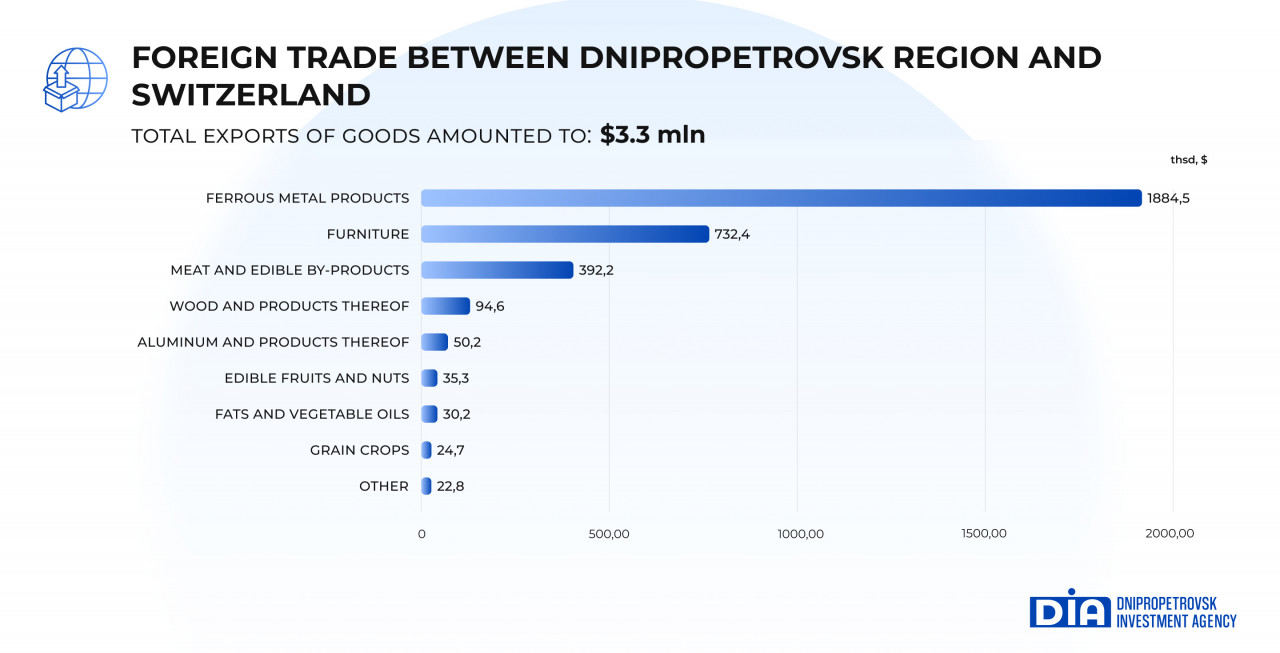
Export operations were carried out by more than 20 enterprises from Dnipropetrovsk region. The main exporting companies are metallurgical, food, agricultural and processing enterprises.
TOP 5 exporting enterprises (ranked by volume of export production):
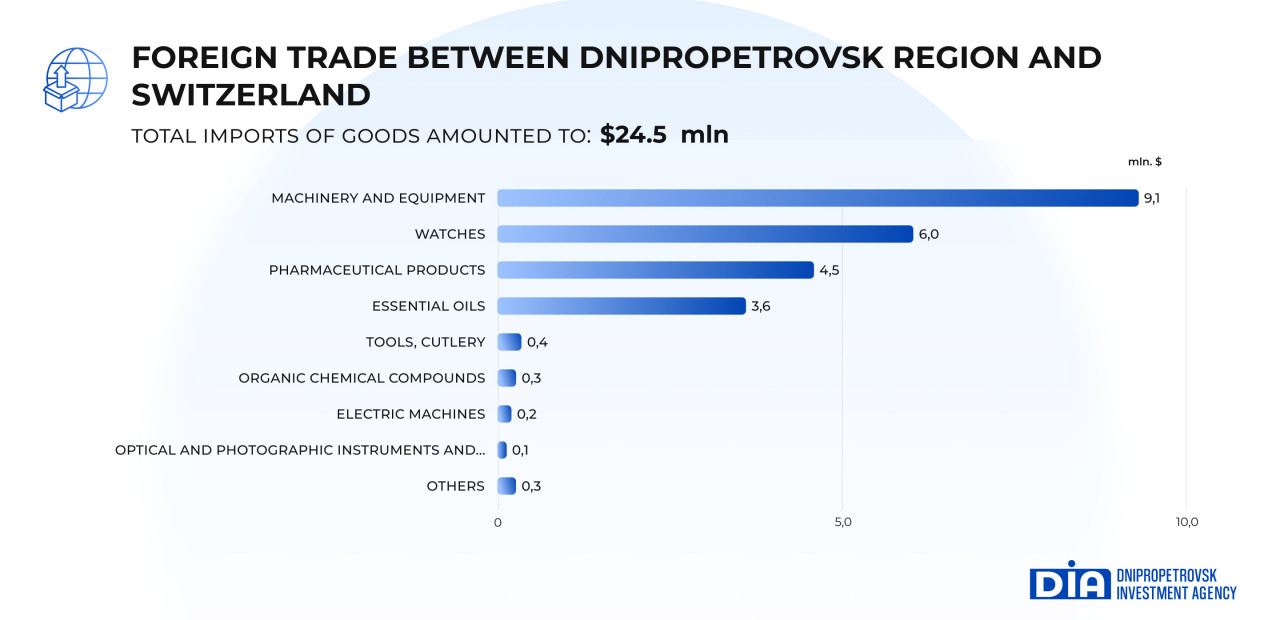
Imports of goods from Switzerland into Dnipropetrovsk region amounted to $24.5 million and increased by 56.8% compared with 9 months of 2024. Dnipropetrovsk region has traditionally purchased: machinery and equipment, watches and clocks, pharmaceutical products, essential oils, tools, cutlery and other goods.
Import operations were carried out by more than 140 importing enterprises.
TOP 5 importing enterprises (ranked by volume of import production):
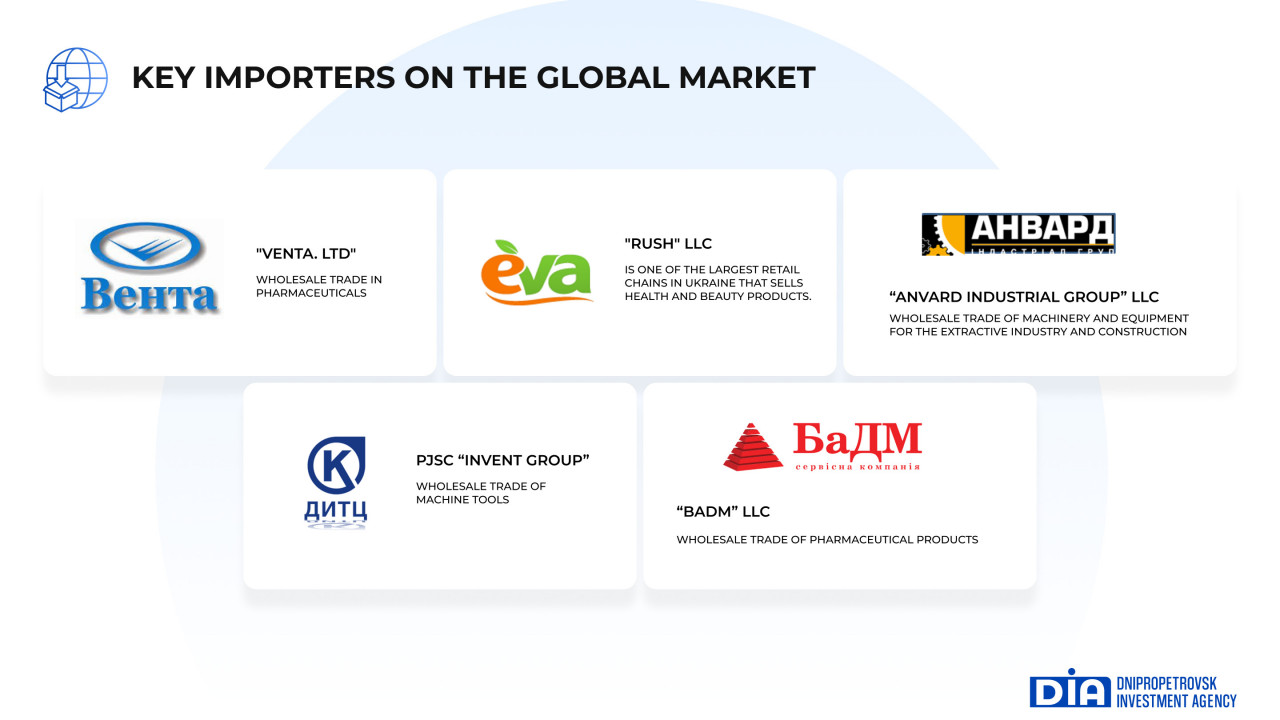
Import operations were carried out predominantly by pharmaceutical, trading, machine-building and processing enterprises.
Source: information for preparing the article was taken from open online sources